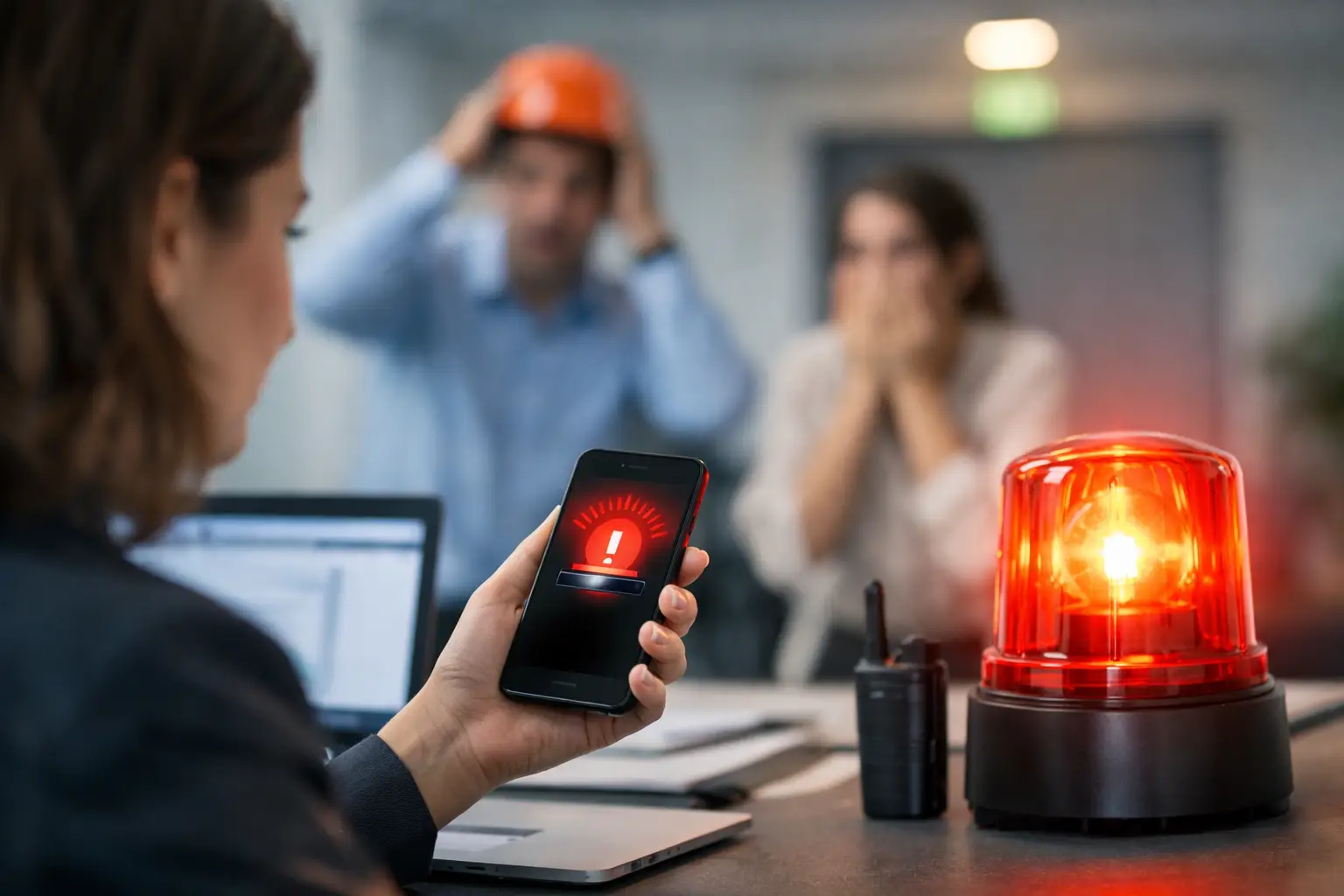
A late-night employee leaves the office garage, sees someone circling the lot, and hesitates. In that moment, safety depends on more than a hotline number or a mass text tool. An employee safety alert system has to do one job well: detect risk fast, escalate it correctly, and help the organization act without confusion.
That standard matters because most companies still manage employee safety through disconnected tools. One platform handles emergency notifications. Another stores incident reports. A third sits with corporate security for travel or executive protection monitoring. HR may track workplace violence concerns in spreadsheets, while managers rely on phone trees during a crisis. The result is delay, duplication, and blind spots exactly when speed and clarity matter most.
What an employee safety alert system is really for
At a basic level, an employee safety alert system sends notifications when people face danger. But for organizations responsible for employee protection, that definition is too narrow. The system should support the full operational cycle – prevention, reporting, escalation, response, and documentation.
That means it should not only push alerts, but also receive them. Employees need a direct way to signal distress, report suspicious behavior, share evidence, and request immediate help. Security teams need visibility into where the threat is, who may be affected, what has already been reported, and whether the situation is isolated or growing.
A useful system also recognizes that not every event is the same. A severe weather warning, an active threat, a stalking concern, and a medical emergency each require different workflows. If every alert triggers the same process, teams either overreact or miss critical details. Neither is acceptable when employee safety is on the line.
The difference between alerting and protection
Many organizations buy notification software and assume they have covered the problem. They have not. Alerting is only one function within protection operations.
A simple notification tool can broadcast a message quickly. That is valuable during a building evacuation or weather closure. But employee safety incidents are often messy, localized, and fluid. An employee may need to discreetly trigger an SOS without drawing attention. A field worker may need location-aware support. A security leader may need analyst-reviewed information before escalating a potential threat across multiple sites.
Protection requires judgment. It requires triage. It requires the ability to distinguish a broad disruption from a targeted risk event. The best systems support that decision-making process instead of adding more noise.
Core capabilities that matter most
A credible employee safety alert system starts with real-time alert delivery across multiple channels. Mobile push, SMS, email, and in-app notifications all have a role because employees do not operate in one environment. Office staff, remote workers, drivers, and traveling executives have different communication realities. Redundancy is not a luxury. It is part of response reliability.
Just as important is two-way communication. During an incident, leadership needs more than message delivery receipts. They need status confirmation, distress signals, and updates from the people involved. Employees should be able to confirm they are safe, request help, or provide incident details without searching for the right contact.
Location awareness is another operational requirement. If a threat is tied to a building, parking area, route, or city block, broad company-wide messaging can create confusion. Geotargeted alerting helps security teams notify the right people while avoiding unnecessary alarm for everyone else. It also improves response coordination when the system can identify who is near the incident zone.
An SOS function is equally important, especially for lone workers, traveling staff, executives, and employees leaving facilities after hours. But the button itself is only part of the answer. What matters is what happens next. Who receives the alert? Is it routed to internal security, a monitoring team, local responders, or all three? Is the employee’s location available? Can the system preserve evidence and timestamps? Without a clear escalation path, SOS becomes a false promise.
Incident documentation should also be built in, not bolted on later. Photos, video, notes, witness details, and timestamps create a record that supports investigation, legal review, HR action, and pattern detection. Organizations that separate alerting from case management often lose context between the first report and the final resolution.
Why fragmented safety tools create risk
Security leaders rarely struggle because they lack software. More often, they struggle because each function sits in a different system with a different owner. HR may manage harassment or workplace violence reporting. Corporate security may monitor travel and access threats. Facilities may handle building emergencies. Executive protection may run separate intelligence workflows for high-risk personnel.
When those streams do not connect, no one has a complete operating picture. A concerning report about a former employee, a suspicious visitor near a parking area, and an executive travel alert may appear unrelated until the risk has already advanced. Centralization matters because threat indicators often emerge in pieces.
This is where platform design has a direct impact on prevention. A unified operating environment can bring together alerts, analyst review, case notes, incident evidence, and response workflows in one place. That shortens the time between detection and action. It also reduces the chance that a serious concern gets trapped in one department’s queue.
Where human verification still matters
Automation helps with speed, scale, and pattern recognition. It does not replace experienced judgment. An employee safety alert system that relies only on automated triggers can produce too many false positives or miss the nuance that determines whether a threat is credible.
For example, a social media mention near a company site may be irrelevant, or it may be an early warning sign tied to a known grievance. A panic alert may be accidental, or it may indicate a genuine confrontation where the employee cannot safely speak. Context changes response.
That is why hybrid models deserve attention. AI can surface anomalies, monitor volumes of data, and support rapid routing. Human analysts can verify, prioritize, and escalate with discipline. For organizations managing workplace violence concerns, executive protection, or multi-site operations, that combination is often more reliable than automation alone.
How to evaluate an employee safety alert system
The first question is not whether the platform sends alerts. Most do. The better question is whether it fits the risk profile of your workforce.
A manufacturing employer may prioritize facility incidents, lone worker support, and after-hours response. A healthcare group may need fast escalation for aggressive behavior, duress alerts, and incident evidence capture. A professional services firm with traveling executives may care more about location-based threat visibility, discreet SOS, and centralized monitoring. The system should reflect those realities, not force every risk type into the same workflow.
Decision-makers should also look closely at escalation design. If an employee triggers an alert at 11:40 p.m., who owns that event? If the first contact fails to respond, what is the backup path? If a manager receives a notification but lacks training, does the system route simultaneously to security professionals who can coordinate next steps? Response architecture matters more than interface design.
Another practical issue is adoption. Employees will not use a safety tool that feels confusing, intrusive, or performative. The reporting path has to be simple under stress. Training has to be clear. Privacy expectations have to be defined. The strongest system is the one people trust enough to use early, before a threat becomes a crisis.
Organizations should also ask whether the platform supports trend analysis over time. Safety operations improve when leaders can identify repeat locations, recurring subjects, time-of-day patterns, and response gaps. An isolated alert might be manageable. A pattern is an intelligence signal.
The standard is operational readiness
An employee safety alert system should do more than broadcast urgent messages. It should strengthen command, shorten response time, preserve evidence, and help organizations move from reactive reporting to active protection.
For companies serious about workforce safety, the benchmark is operational readiness. That means verified intelligence, clear escalation, coordinated workflows, and one place to manage the event from first alert to final record. Platforms built for that mission, including systems like Risk Shield, are not just communication tools. They are part of the protective infrastructure.
When an employee needs help, the organization should not be improvising. The right system makes sure it does not have to.
