A credible corporate threat intelligence guide starts with a hard truth: most organizations do not fail because they lacked data. They fail because signals were scattered, ownership was unclear, and action came too late. Security teams had one view, HR had another, executives got partial updates, and critical context never reached the people responsible for prevention.
That gap is where threat intelligence becomes operational. Not as a collection of alerts, and not as a quarterly report that sits in a folder, but as a disciplined process for identifying risk, validating relevance, escalating correctly, and supporting decisions before an incident expands.
What a corporate threat intelligence guide should actually cover
For enterprise teams, threat intelligence is often discussed too broadly. Some use it to mean cyber indicators. Others mean geopolitical updates, workplace violence signals, executive protection concerns, or social media monitoring. In practice, corporate threat intelligence should cover the threats that can disrupt people, operations, facilities, and leadership.
That includes physical security risks, targeted threats against executives or employees, protests near offices, travel-related disruptions, insider concerns, online leakage of intent, and emerging patterns that suggest a higher chance of escalation. The goal is not to collect everything. The goal is to collect what can change posture, trigger intervention, or support a measured response.
A useful program answers four questions consistently. What is happening? Why does it matter to this organization? Who needs to know now? What action should follow? If your current process cannot answer those questions quickly, it is producing noise rather than intelligence.
Intelligence without operations creates blind spots
Many organizations invest in monitoring tools, but the operating model stays fragmented. Alerts arrive in different systems. Incidents are documented in different formats. Assessment criteria vary by team. By the time leadership asks for a clear risk picture, the organization is already behind the event.
That is why an effective program has to connect monitoring, assessment, escalation, and case management. Detection alone is not enough. If a threat involving an employee appears online, the organization needs a way to validate the source, assess intent and capability, document evidence, notify the right stakeholders, and decide whether the situation belongs with corporate security, HR, legal, executive protection, or law enforcement.
This is also where trade-offs matter. A highly sensitive monitoring posture may capture more early indicators, but it can overwhelm analysts and business leaders with low-value alerts. A tighter threshold may reduce noise, but it can miss weak signals that become serious later. The right balance depends on the organization’s risk profile, geographic footprint, public exposure, and duty-of-care obligations.
Building a corporate threat intelligence program
The strongest programs are built around decisions, not dashboards. Start by defining the decisions intelligence must support. That may include whether to increase security presence at a site, whether to investigate an employee concern, whether to adjust executive travel, whether to notify local leadership, or whether to activate incident response.
Once those decision points are clear, define priority intelligence requirements. These are the threat questions that matter most to your organization. A healthcare system may focus on workplace violence indicators, facility disruptions, and patient-related threats. A financial firm may emphasize executive targeting, protest activity, insider risk, and travel exposure. A distributed employer may prioritize employee safety, regional instability, and digital signals tied to physical harm.
Source selection comes next. Publicly available information, social media, local reporting, internal reporting channels, travel advisories, incident records, and analyst research all have value, but not equally in every situation. More sources do not automatically mean better intelligence. Unverified inputs can increase false positives, slow triage, and create unnecessary escalation.
For that reason, mature teams combine technology with analyst review. Automated collection helps scale monitoring and identify patterns quickly. Human verification helps determine relevance, context, credibility, and urgency. That hybrid model is often the difference between a stream of raw alerts and an operational picture leaders can trust.
The role of threat assessment and escalation
Threat intelligence only matters if it changes action. That requires a clear assessment framework.
At minimum, organizations should establish common criteria for evaluating threats. Is there evidence of intent? Is there capability? Is the target specific? Is there a timeline? Has behavior escalated? Is there a known grievance, fixation, or pattern of leakage? These questions are essential in workplace violence prevention, executive protection, and employee safety cases because they move teams beyond instinct and toward structured judgment.
Escalation paths should also be defined before an event occurs. Too many organizations improvise roles during live incidents. Security assumes HR will handle an employee issue. HR assumes security is monitoring. Legal enters late. Executive leadership receives fragmented updates. That confusion creates delay at the worst possible moment.
A disciplined escalation model assigns ownership by scenario, defines who receives immediate alerts, and sets thresholds for when a concern becomes a case, an investigation, or an active incident. It should also account for after-hours coverage. Threats do not respect business hours, and neither should the monitoring model behind your response.
Centralization is a security advantage
One of the biggest weaknesses in corporate threat intelligence is fragmentation. Monitoring happens in one tool. Incident notes live in email. Evidence is stored on local drives. Travel risk is tracked elsewhere. Executive protection teams maintain separate processes. That structure makes trend detection harder and post-incident review weaker.
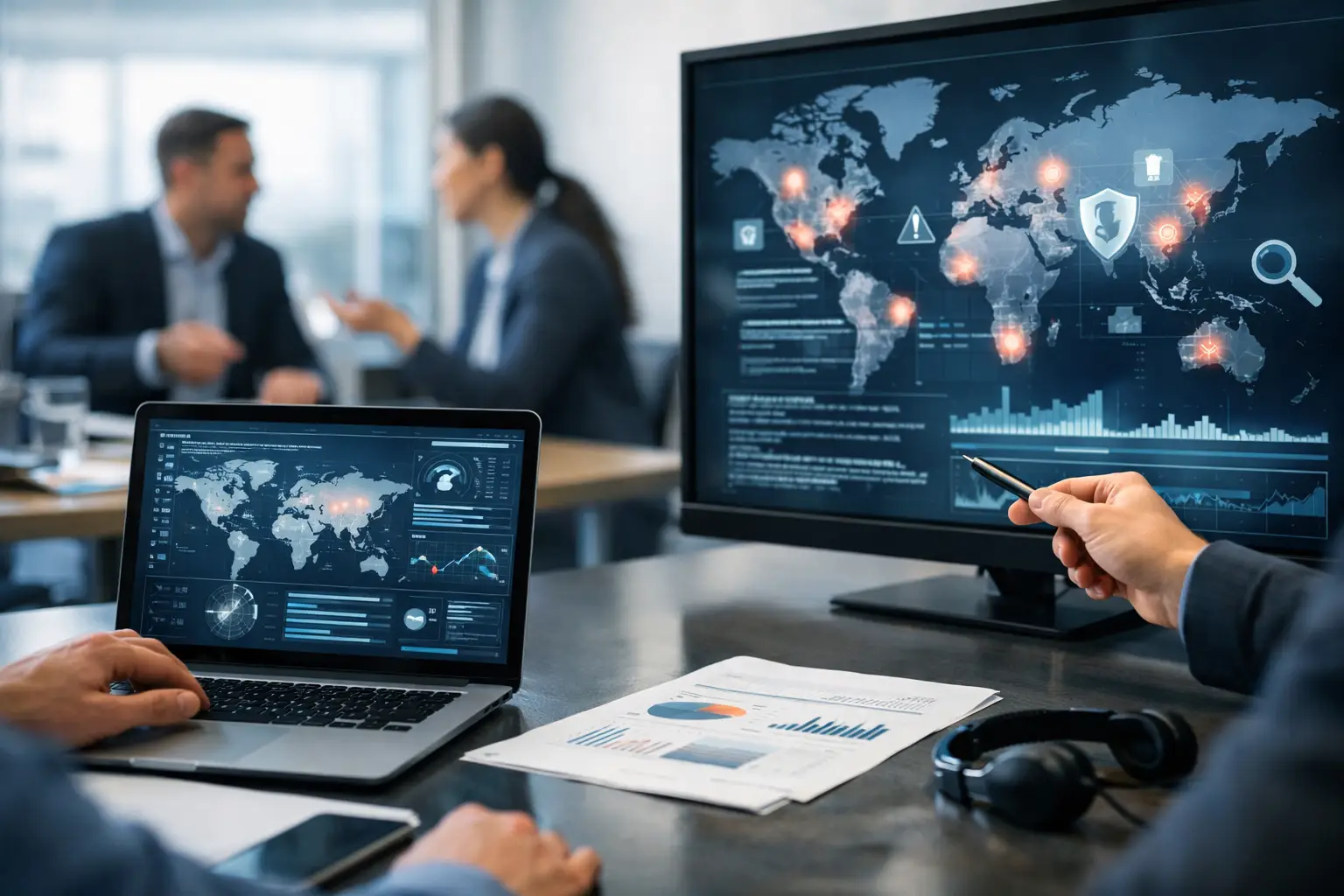
A centralized operating environment improves both prevention and response. It creates one place to log alerts, attach evidence, track decisions, assign actions, and measure outcomes. It also helps organizations identify patterns that would otherwise be missed, such as repeated threats tied to a single individual, increasing activity around a facility, or recurring employee safety concerns in a region.
This matters for governance as much as for speed. When leadership asks what was known, when it was known, and what actions were taken, a centralized record supports accountability. It also improves handoffs across corporate security, HR, legal, operations, and executive stakeholders.
What good looks like in daily practice
A strong program is not defined by how many alerts it generates. It is defined by whether relevant threats are identified early, assessed correctly, and turned into timely action.
In daily practice, that means teams receive intelligence tailored to their exposure, not a generic flood of updates. Site leaders get location-specific visibility. Executive protection teams get intelligence tied to routes, venues, and individuals. HR and workplace safety leaders get structured support for concerning behavior cases. Corporate security gets a unified view that connects prevention, documentation, and response.
It also means measuring the right things. Volume metrics can be misleading. More useful measures include time to validation, time to escalation, reduction in false positives, case closure speed, repeat threat patterns, and how often intelligence led to a preventive action. These indicators show whether the program is improving security outcomes or simply increasing activity.
Common mistakes that weaken threat intelligence
The first mistake is treating intelligence as a reporting function instead of an operational discipline. Reports have value, but they do not protect people by themselves.
The second is separating intelligence from response. If the team that detects risk has no path to trigger action, the organization is slower than it appears.
The third is relying on automation without verification. Speed matters, but context matters more. A false alert can waste time and erode trust. A verified alert with clear relevance earns attention and drives action.
The fourth is building around a single threat type. Corporate exposure is rarely isolated. Executive risk, workplace violence concerns, facility disruptions, travel threats, and online indicators often overlap. Programs built in silos miss that connection.
Where this is heading
The next phase of corporate threat intelligence is integration. Organizations are moving away from isolated tools and toward operating models that combine monitoring, analyst review, threat assessment, documentation, and coordinated response. That shift is not about convenience. It is about making faster, more defensible decisions when risk is rising.
For organizations responsible for employee protection, executive safety, and continuity of operations, the standard is changing. Generic alerting is no longer enough. Leaders need verified intelligence, clear workflows, and a system that supports both prevention and escalation. That is the difference between seeing a threat and managing it.
Risk Shield reflects that direction through a unified approach that combines AI-driven monitoring with human-verified analysis and operational response tools. For security leaders, that model solves a practical problem: turning scattered signals into action before they become incidents.
The most effective corporate threat intelligence guide is the one your team can execute under pressure, with confidence, before the situation forces your hand.
