
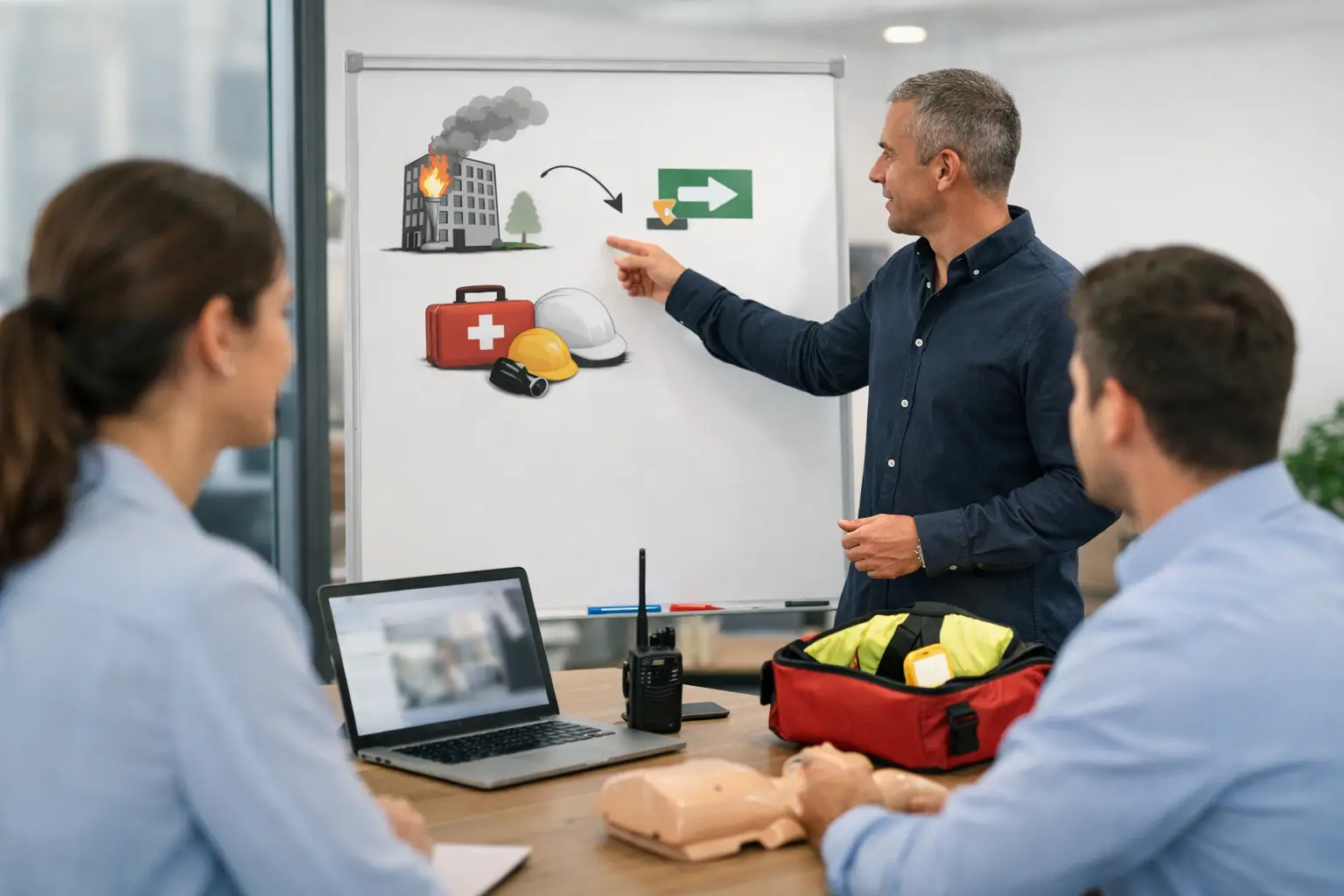
A workplace emergency rarely begins with complete information. It begins with a concerning message, an alarm, a missed check-in, a threatening call, or a report that may or may not be accurate. An effective employee emergency response planning guide gives leaders a disciplined way to verify the threat, protect people, escalate with purpose, and document every critical decision.
The objective is not to create a binder that sits untouched until an audit. It is to build an operational system employees can use under pressure, across offices, remote work locations, job sites, and travel. When seconds matter, people need clear authority, reliable communications, and instructions that match the threat in front of them.
Start With the Risks Your Organization Actually Faces
A generic evacuation plan cannot cover every emergency. Organizations should assess the events most likely to disrupt operations or endanger personnel based on location, industry, workforce profile, facilities, and public visibility. A corporate headquarters, manufacturing site, school, healthcare setting, retail location, and distributed remote workforce will not face the same exposures.
For most organizations, planning should address severe weather, fire, medical emergencies, utility failures, suspicious packages, active threats, workplace violence, civil unrest, cyber incidents that affect operations, and missing or overdue employees. Executive teams and travel-intensive organizations may also need procedures for targeted threats, stalking, executive protection incidents, and location-specific civil disruption.
The key distinction is between a hazard and a decision point. “Severe weather” is a hazard. “Move staff from exterior offices to designated shelter areas when a tornado warning covers the facility” is an actionable decision point. Every plan should identify what triggers action, who confirms the information, who has authority to act, and what employees must do next.
Define Command Before an Incident Begins
Confusion over authority slows response. A sound plan establishes a small incident command structure before an emergency, with named primary and backup personnel for each role. The structure should work after hours and account for a leader who is unavailable, traveling, or directly involved in the incident.
The incident lead directs the response and decides when to escalate. The security or safety lead gathers facts, coordinates protective measures, and liaises with first responders. Human resources manages employee welfare, family communications, and employment-related considerations. Facilities handles building systems, access controls, utility shutoffs, and assembly points. Communications provides approved employee, customer, and public messaging.
These responsibilities can overlap in smaller organizations. What cannot overlap is authority. Employees should know who can order an evacuation, shelter-in-place action, site closure, emergency notification, or law enforcement call. They should also know that anyone can report a concern and activate an SOS process without waiting for management approval when there is an immediate threat to life or safety.
Build Escalation Thresholds, Not Vague Instructions
“Notify management” is not an escalation protocol. It creates delay and leaves employees guessing whether a report is serious enough to share. Replace vague language with defined thresholds.
For example, a credible threat against a named employee, a weapon report, forced entry, or violence in progress requires immediate 911 notification and internal incident activation. A suspicious person near a controlled entrance may require security dispatch, camera review, access restriction, and a decision on whether to notify staff. A social media threat may require preservation of evidence, threat assessment, and analyst review before broad communication.
Not every concern warrants a facility-wide alert. Over-alerting can create panic, disrupt operations, and cause employees to ignore future messages. Under-alerting leaves people exposed. The correct response depends on credibility, proximity, capability, intent, and time sensitivity. This is where verified intelligence and trained human judgment matter more than raw alert volume.
Build the Employee Emergency Response Planning Guide Around Actions
Employees should not have to interpret legal language or search a lengthy document during a crisis. Their instructions must be brief, specific, and available in more than one format. Mobile access matters, but so do posted procedures, desk references, supervisor briefings, and accessible alternatives for employees with disabilities or limited device access.
For each scenario, state the immediate action first. In an evacuation, employees should leave by the safest available route, avoid elevators unless directed otherwise, report to a designated assembly area, and check in. During a shelter-in-place event, they should move to the designated interior area, secure access points where appropriate, and wait for official direction. During an active threat, instructions must reflect the organization’s training and local law enforcement guidance, with safety taking priority over property and routine reporting lines.
A plan should also address people who may need additional support. This includes employees and visitors with mobility, hearing, vision, cognitive, or medical needs, as well as contractors, clients, and temporary workers who may not know the facility. Assigning support partners can help, but the plan must avoid assuming one person will always be available. Build redundancy into assistance procedures.
Create a Communication System That Holds Up Under Pressure
Emergency communication is more than sending a text. It is a cycle: receive a report, verify what can be verified, issue protective instructions, confirm employee status, update leadership, and preserve the record.
Use multiple communication paths because any single channel can fail. This may include mass notification, mobile alerts, phone calls, email, collaboration tools, desktop notifications, public address systems, and supervisors communicating face to face. Messages should come from recognizable sources and use plain language. Employees need to know the location, the required action, the urgency, and where to get verified updates.
A useful emergency message answers four questions: What happened? Where is the threat or impact area? What should I do now? When will the next update arrive? Avoid speculation, unverified casualty information, and reassurance that is not supported by facts.
Two-way accountability is equally critical. A message sent is not a workforce accounted for. Employees need a simple way to mark themselves safe, request assistance, report their location, upload evidence, or identify others who may still be at risk. For remote and traveling personnel, location-aware safety tools can help security teams prioritize outreach without forcing a one-size-fits-all response.
Train for Judgment, Not Just Compliance
An annual drill can satisfy a requirement while revealing little about actual readiness. Effective exercises test the decisions people will face: conflicting reports, unavailable leaders, blocked exits, a communication platform outage, an employee who does not check in, or a threat that develops outside normal business hours.
Start with tabletop exercises for leadership and incident teams. Walk through a realistic scenario minute by minute, ask who acts, and identify where the plan breaks down. Then conduct functional drills that test communication, accountability, access control, and coordination with local responders where appropriate. Full-scale exercises may be justified for higher-risk facilities, but they require careful planning to prevent unnecessary alarm or operational disruption.
After every drill or live event, conduct a structured after-action review. Record what happened, what worked, where decisions were delayed, which systems failed, and who owns each corrective action. A lesson that is not assigned, tracked, and retested is not a lesson learned.
Centralize Information and Evidence During the Response
Emergency operations often fail because information is scattered across texts, personal phones, emails, radio traffic, camera systems, and handwritten notes. That fragmentation creates blind spots, complicates handoffs, and weakens the organization’s ability to defend its actions later.
A centralized incident record should capture the initial report, verification steps, alerts sent, employee status, responding agencies, decisions made, evidence received, and recovery actions. It should preserve timestamps and clarify who made each decision. Access must be role-based, particularly when cases involve medical information, workplace violence concerns, protected employee data, or an ongoing law enforcement matter.
Risk Shield’s intelligence-led approach supports this operating model by bringing threat monitoring, escalation workflows, employee SOS reporting, evidence collection, and case management into a unified response environment. The practical advantage is not more technology for its own sake. It is faster visibility when a dispersed team needs one verified operating picture.
Keep the Plan Current as Conditions Change
Emergency plans degrade quietly. A new office opens, a floor layout changes, a key leader leaves, a vendor changes, or a major local event creates a new exposure. Review the plan at least annually, after a significant incident or exercise, and whenever there is a material change to personnel, facilities, operations, or threat conditions.
Confirm emergency contacts, assembly areas, floor wardens, responder access procedures, medical supplies, notification lists, and employee accommodation needs. Review vendor and landlord responsibilities as well. In a shared building, unclear boundaries between tenant security, property management, and local responders can create dangerous delays.
Preparedness is proven in the first few minutes of an incident, when facts are incomplete and decisions carry consequences. Give your people a plan they can act on, a clear path to escalate concerns, and the confidence that a verified response is already in motion.
