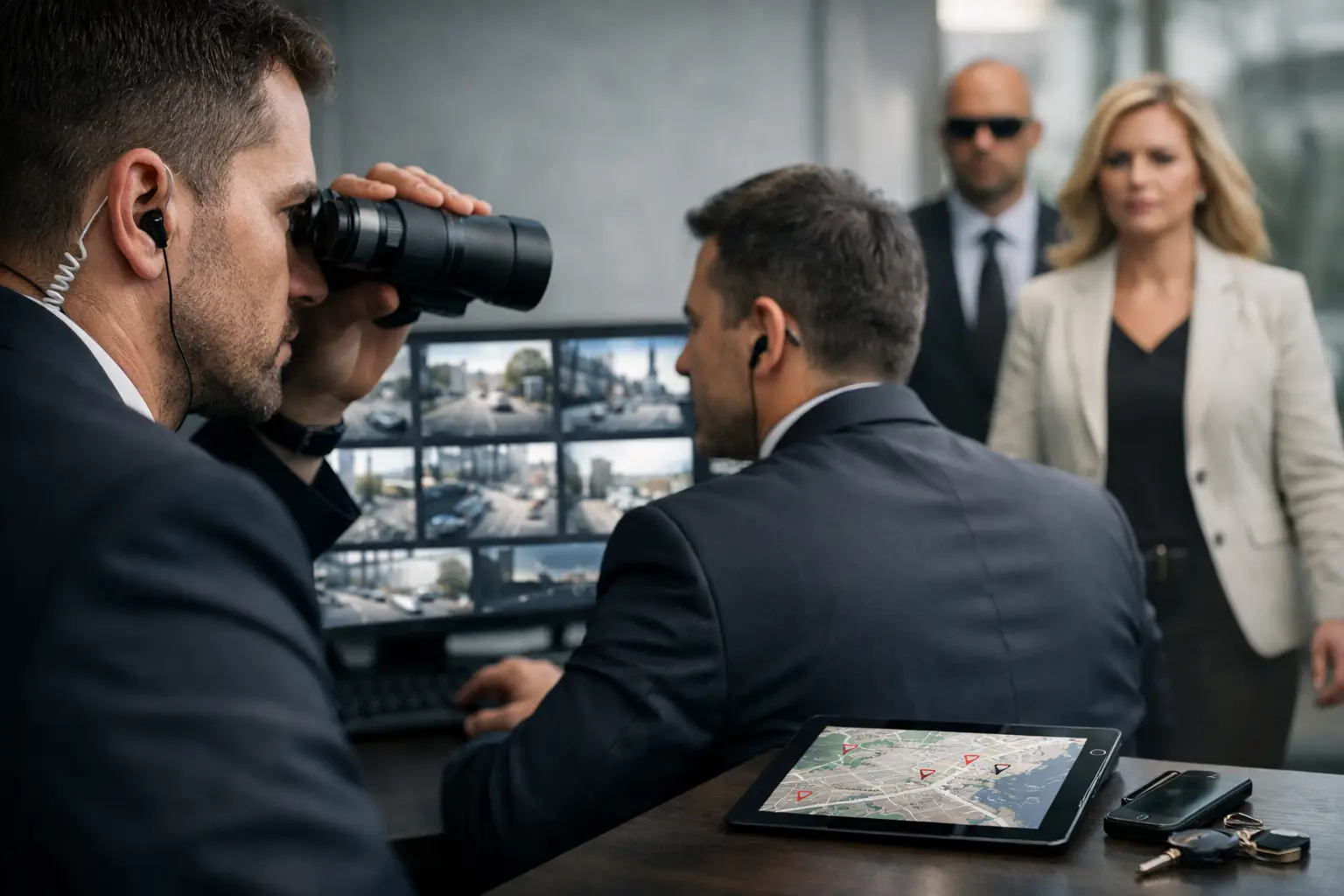
A concerning post appears at 11:14 p.m. It mentions an executive by name, includes a location, and carries just enough specificity to make people uneasy. By morning, the question is no longer whether security should act. It is whether anyone saw the signal early enough to prevent the escalation.
That is where protective intelligence services matter. At their best, they do not just collect information. They identify threat indicators, test credibility, connect fragmented signals, and give decision-makers a clear path to prevention. For corporate security leaders, executive protection teams, HR, and families with elevated exposure, that distinction is the difference between monitoring noise and managing risk.
What protective intelligence services actually cover
Protective intelligence services sit at the intersection of threat monitoring, risk assessment, and operational response. The work often starts before there is a formal incident. A subject of concern may be posting fixation-based language online. An employee termination may introduce elevated workplace violence risk. A public event may increase exposure for a principal whose travel details are circulating more widely than expected.
In each case, the mission is the same: detect relevant signals early, assess whether they indicate intent or capability, and support actions that reduce the chance of harm. That may include monitoring open-source channels, reviewing behavioral indicators, analyzing geographic proximity, documenting incidents, and escalating to security, legal, HR, or law enforcement when thresholds are met.
This is not the same as broad media monitoring, and it is not the same as a one-time background check. Protective intelligence is focused, continuous, and operational. It asks practical questions. Who or what presents a threat? How credible is it? What has changed? Who needs to know now? What action should happen next?
Why organizations use protective intelligence services
Most serious security failures are not caused by a total absence of information. They happen because signals were scattered across too many systems, misread as low priority, or left without ownership. Email screenshots sit in one inbox. A concerning social post is reported to another team. An employee complaint lives in HR. Travel risk sits with an executive assistant. By the time a pattern is visible, the window for prevention may be narrowing.
Protective intelligence services create structure around that problem. They centralize collection, establish analytic criteria, and turn scattered data into a defensible risk picture. For organizations, that means faster escalation and fewer blind spots. For executive protection teams, it means better advance work and more precise resource deployment. For individuals and families, it means having verified intelligence instead of relying on generic alerts that offer little context.
The value is not just speed. It is judgment. A high volume of alerts can overwhelm teams if nobody is separating casual hostility from credible intent. Human review matters because language, timing, repetition, and context all influence threat posture. A machine may detect a keyword. An experienced analyst can identify fixation, grievance progression, leakage, or behavioral changes that raise the stakes.
The core components of effective protective intelligence services
A credible program usually combines technology, trained analysts, and clear workflows. Remove any one of those, and performance drops.
Technology helps with scale. It can monitor large volumes of open-source information, flag mentions tied to locations or people, detect trend changes, and surface incidents that would be easy to miss manually. That matters when risk develops across multiple channels or outside business hours.
But technology alone is not enough. False positives are common in security monitoring, especially when public figures, executives, or organizations have high digital visibility. Human analysts validate the signal, examine context, and decide whether a finding deserves escalation. That step is what separates meaningful protective intelligence from generic alerting.
Workflows are the third requirement. If a threat analyst identifies credible concern but there is no process for notification, case handling, evidence retention, or response coordination, the intelligence loses operational value. Strong protective intelligence services support the full chain: detection, assessment, documentation, escalation, action, and review.
Where protective intelligence services make the biggest difference
Executive protection is one of the clearest use cases. Public-facing leaders attract attention, and not all of it is benign. Travel schedules, media exposure, litigation, layoffs, and controversial decisions can increase threat activity quickly. Protective intelligence helps teams understand who is showing fixation, where exposure is rising, and when protective posture should change.
Workplace violence prevention is another critical area. Many incidents are preceded by warning behaviors, direct or indirect threats, grievances, or concerning changes in conduct. Protective intelligence services help organizations capture and assess those indicators before they are dismissed as isolated events. This is especially important when information is split between HR, security, legal, and frontline managers.
Schools, healthcare systems, faith-based organizations, and community sites also benefit because they face a difficult mix of public access, reputational visibility, and duty of care. In those environments, protective intelligence supports early intervention and more disciplined incident management.
For private clients, the use case often centers on stalking, harassment, travel risk, and family safety. Here, context becomes even more important. A message that seems trivial to an outsider may be part of a larger escalation pattern when reviewed against prior contact attempts, location references, and timeline changes.
What to look for when evaluating protective intelligence services
Not every provider operates at the same level. Some offer broad alert feeds with limited validation. Others provide boutique analysis but lack scalable tooling or incident coordination. The right fit depends on your risk profile, internal resources, and response obligations.
Start with analytic discipline. Ask how threats are assessed, what criteria trigger escalation, and whether analysts have experience in investigations, threat assessment, executive protection, or law enforcement. Protective intelligence is not just about collecting data. It is about making defensible decisions under pressure.
Then examine operational integration. Can the service support case management, evidence capture, and coordinated response? Can alerts be tied to location, principal, travel, facility, or incident type? If the output arrives as disconnected emails, your team may still be left stitching the picture together.
Coverage model matters too. Some organizations need continuous monitoring with around-the-clock escalation. Others need targeted support tied to events, travel, employee actions, or elevated periods of concern. There is no universal model, and overbuying can be just as inefficient as underpreparing.
Privacy and legal boundaries should also be part of the discussion. Protective intelligence must be conducted within lawful and ethical limits, especially when employee-related matters are involved. A mature provider understands those constraints and documents activity carefully.
The trade-off between volume and precision
One of the most common mistakes in security operations is confusing more data with better intelligence. Large alert volumes can create a false sense of coverage while making real threats harder to identify. Teams begin to tune out. Escalation thresholds become inconsistent. Fatigue sets in.
Effective protective intelligence services aim for precision, not just reach. That means refining watch criteria, reducing irrelevant noise, and tailoring monitoring to actual exposure. A principal with heavy public visibility may need a different model than a regional office concerned about insider risk. A healthcare system facing targeted grievance behavior may need different escalation rules than a family office managing travel and privacy concerns.
This is where a hybrid model stands out. AI can process speed and scale. Human analysts apply judgment, pattern recognition, and operational context. Together, they produce intelligence that is more usable in the real world. That is especially valuable when timing matters and response decisions carry legal, reputational, or safety consequences.
Turning intelligence into prevention
Protective intelligence only matters if it changes what happens next. A credible assessment should inform decisions about protective posture, travel modifications, facility awareness, employee safety actions, or law enforcement coordination. It should also leave a documented trail that supports accountability and post-incident review.
For many organizations, the next step is consolidation. When threat monitoring, incident documentation, executive protection workflows, and emergency response tools operate separately, prevention becomes harder than it needs to be. A unified approach gives teams a common operating picture and a clearer chain of action. That is why platforms such as Risk Shield are gaining traction with organizations that want verified intelligence tied directly to response operations, rather than another disconnected stream of alerts.
Protective intelligence services are most valuable before a crisis looks obvious. The earlier you can identify escalation, validate credibility, and coordinate action, the more options you have. In security, that is the advantage that matters most: not reacting faster after harm begins, but seeing enough soon enough to prevent it.
