A concerning social media post appears at 11:47 p.m. A regional protest begins shifting toward a company facility. An employee reports escalating threats from a former colleague. In each case, the difference between a manageable event and a high-impact incident can come down to whether the right team sees the signal, understands it, and acts before conditions worsen.
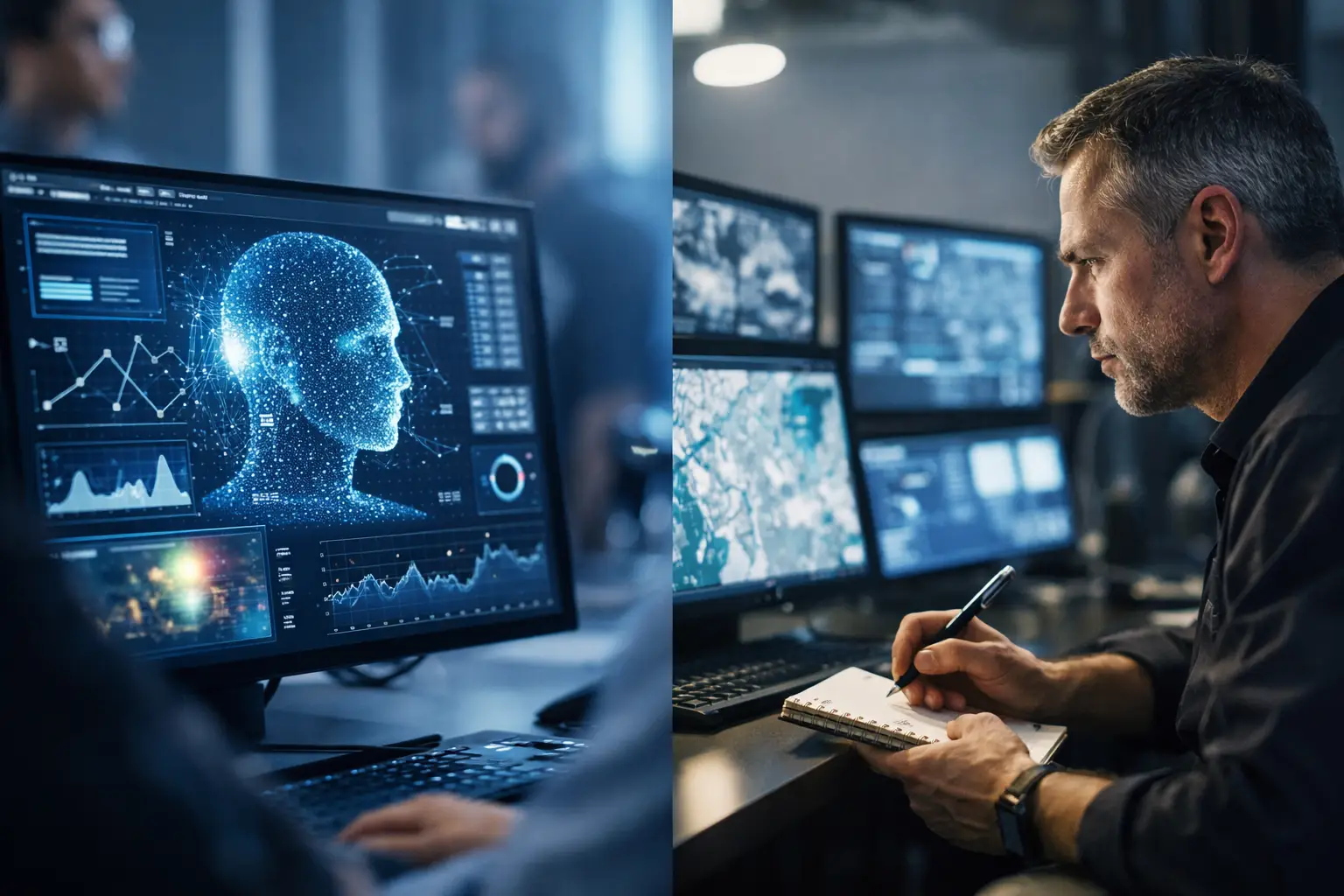
AI risk analytics vs manual monitoring is not a debate about replacing security professionals. It is a decision about how security operations can maintain visibility across more locations, data sources, and emerging threats without sacrificing the judgment required to make defensible decisions. For organizations responsible for people, facilities, executives, and critical operations, the strongest model combines machine-scale detection with trained human assessment.
Why Manual Monitoring Reaches a Breaking Point
Manual monitoring has clear value. Skilled analysts can recognize context, identify credibility gaps, distinguish routine noise from a meaningful warning, and understand the operational consequences of an alert. An experienced investigator may see language, timing, prior conduct, or location details that an automated system cannot fully interpret on its own.
The problem is volume. Open-source intelligence, news reports, weather events, public safety feeds, employee reports, access-control events, and internal case records do not arrive in orderly intervals. They arrive continuously, often across disconnected tools. A security team relying primarily on manual review must decide where to look, what to prioritize, and what can wait. That creates blind spots during overnight hours, weekends, high-volume news cycles, and active incidents.
Manual workflows also make consistency harder to maintain. One analyst may document a concerning post as an actionable threat; another may classify it as informational. Without centralized workflows, evidence may sit in email threads, spreadsheets, screenshots, or individual inboxes. The organization loses time reconstructing what was known, when it was known, and whether escalation procedures were followed.
This does not mean manual monitoring is ineffective. It means it is difficult to scale. A small, stable environment with a limited number of sites and a dedicated analyst may rely more heavily on human review. A distributed enterprise, executive protection program, school system, or organization facing elevated workplace violence concerns needs broader and more persistent coverage.
AI Risk Analytics vs Manual Monitoring: The Operational Difference
AI risk analytics processes high volumes of structured and unstructured information at a speed no individual team can match. It can monitor defined risk indicators, identify mentions connected to people or places, detect unusual patterns, correlate events across sources, and surface issues that meet predetermined thresholds.
Manual monitoring, by contrast, depends on an analyst actively locating and reviewing information. It is focused, selective, and often highly accurate when the analyst has strong context. But it is constrained by time, staffing, source coverage, and the natural limits of human attention.
The key difference is not simply speed. It is persistence. AI-supported systems can maintain continuous observation of monitored locations, entities, keywords, and risk categories while human teams focus on validation, investigation, protective decisions, and response coordination.
Consider a corporate security team monitoring risks around a major office. Manual monitoring may identify a planned demonstration once an analyst sees a local report or social post. AI analytics can flag early signals across multiple relevant sources, recognize a growing cluster of activity near the site, and route a prioritized alert to the right personnel. A trained analyst then evaluates intent, credibility, proximity, and likely operational impact before recommending action.
That division of labor reduces the chance that a critical signal is missed while preserving the human responsibility to determine what the signal actually means.
Where AI Creates a Security Advantage
AI delivers the greatest value where the security challenge involves scale, speed, repetition, or correlation. It can help teams identify risks earlier and organize information faster, particularly when threat indicators are scattered across sources.
For location-based protection, analytics can continuously evaluate events near facilities, residences, travel routes, venues, or executive movements. Rather than asking an analyst to repeatedly check every relevant area, the system can identify changing conditions and direct attention to the locations that require review.
For workplace violence prevention, AI can help structure and prioritize incoming reports, behavioral indicators, and related evidence. It cannot determine intent or diagnose an individual. It can, however, make it easier for a threat assessment team to see patterns, document concerns, assign follow-up, and ensure no report disappears into an untracked process.
For incident operations, AI can accelerate triage. It can classify information, identify duplicates, associate incoming reports with an existing case, and notify designated stakeholders based on severity or location. During a rapidly developing event, those seconds and minutes matter. They allow security leaders to shift from searching for information to directing resources.
Analytics also improves after-action visibility. When incidents, alerts, evidence, and actions are captured in one operating environment, leadership can identify recurring risks, response delays, geographic concentrations, and procedural gaps. That is how a security program moves beyond reacting to the last incident and begins preventing the next one.
What AI Cannot Decide
A threat score is not a threat assessment. An alert is not evidence of intent. And automated detection should never be treated as a substitute for legal, investigative, clinical, or security judgment.
AI can produce false positives when language is ambiguous, information is outdated, or an event appears relevant without posing a direct risk. It can also miss signals when data is incomplete, access is limited, or a threat develops outside the sources being monitored. Security leaders should treat analytics as an intelligence layer, not an autonomous decision-maker.
Human review is essential when an alert could trigger actions affecting an employee, student, customer, executive, or member of the public. Analysts provide context that systems cannot reliably establish: whether a subject has a known history, whether a location is actually exposed, whether language is credible, and whether law enforcement, HR, executive protection, or crisis leadership needs to be involved.
Clear escalation criteria are equally important. Teams should define what requires immediate notification, what needs analyst review, who owns the case, and how decisions are documented. Without disciplined workflows, more alerts simply create more noise.
The Hybrid Model: Detection, Verification, Action
The most effective security posture is not AI or people. It is AI-supported monitoring paired with human verification and operational response.
In a hybrid model, technology watches continuously for relevant indicators, correlates information, and prioritizes potential risks. Analysts verify credibility, add context, determine severity, and escalate according to established procedures. Security leaders then have a clearer operational picture: what happened, what is known, what remains uncertain, who is responsible, and what action is underway.
This model is particularly effective for organizations with multiple facilities, mobile employees, high-profile leaders, public-facing operations, or complex duty-of-care requirements. It supports a practical allocation of resources. Analysts spend less time scanning repetitive inputs and more time conducting meaningful investigation, communicating with stakeholders, and preparing protective measures.
Risk Shield applies this approach by bringing AI-driven analytics, analyst support, location-based intelligence, incident workflows, and evidence management into a centralized security environment. The objective is not to generate more notifications. It is to produce actionable intelligence that can be reviewed, documented, and escalated with discipline.
How to Evaluate the Right Monitoring Approach
The right balance depends on your threat profile, geographic footprint, staffing model, and response obligations. A security program should begin by identifying the decisions it must make quickly. If leaders need to protect executives during travel, assess workplace violence concerns, coordinate incident response across sites, or monitor emerging threats near critical facilities, continuous intelligence coverage becomes more valuable.
Evaluate whether your current process can answer several basic questions without delay: Are we monitoring the right sources and locations? Can we distinguish urgent threats from routine information? Can the responsible team receive and acknowledge an alert at any hour? Can we preserve evidence and show a clear record of actions taken?
If the answer depends on one person checking multiple inboxes and browser tabs, the process is vulnerable. If the answer is an automated system that sends every alert directly to leadership, the process is likely creating alert fatigue. The goal is a controlled escalation path that balances coverage with judgment.
AI risk analytics is especially useful when it is configured around real operational requirements rather than generic keywords. A facility may need alerts tied to a specific perimeter. An executive protection team may need travel and venue intelligence. HR and corporate security may need structured intake and case visibility for behavioral concerns. Configuration should reflect the risks your organization is actually responsible for managing.
Build Capacity Before the Next Escalation
Security teams are not measured by how many alerts they receive. They are measured by whether they identify credible risk early, protect people effectively, and direct a coordinated response when conditions change.
Manual monitoring remains indispensable because people make the judgments that carry operational, legal, and human consequences. AI risk analytics expands the team’s field of view, shortens the path from signal to review, and helps preserve the details needed to act with confidence. Build the model around both capabilities, then test it before the next alert demands an answer.
