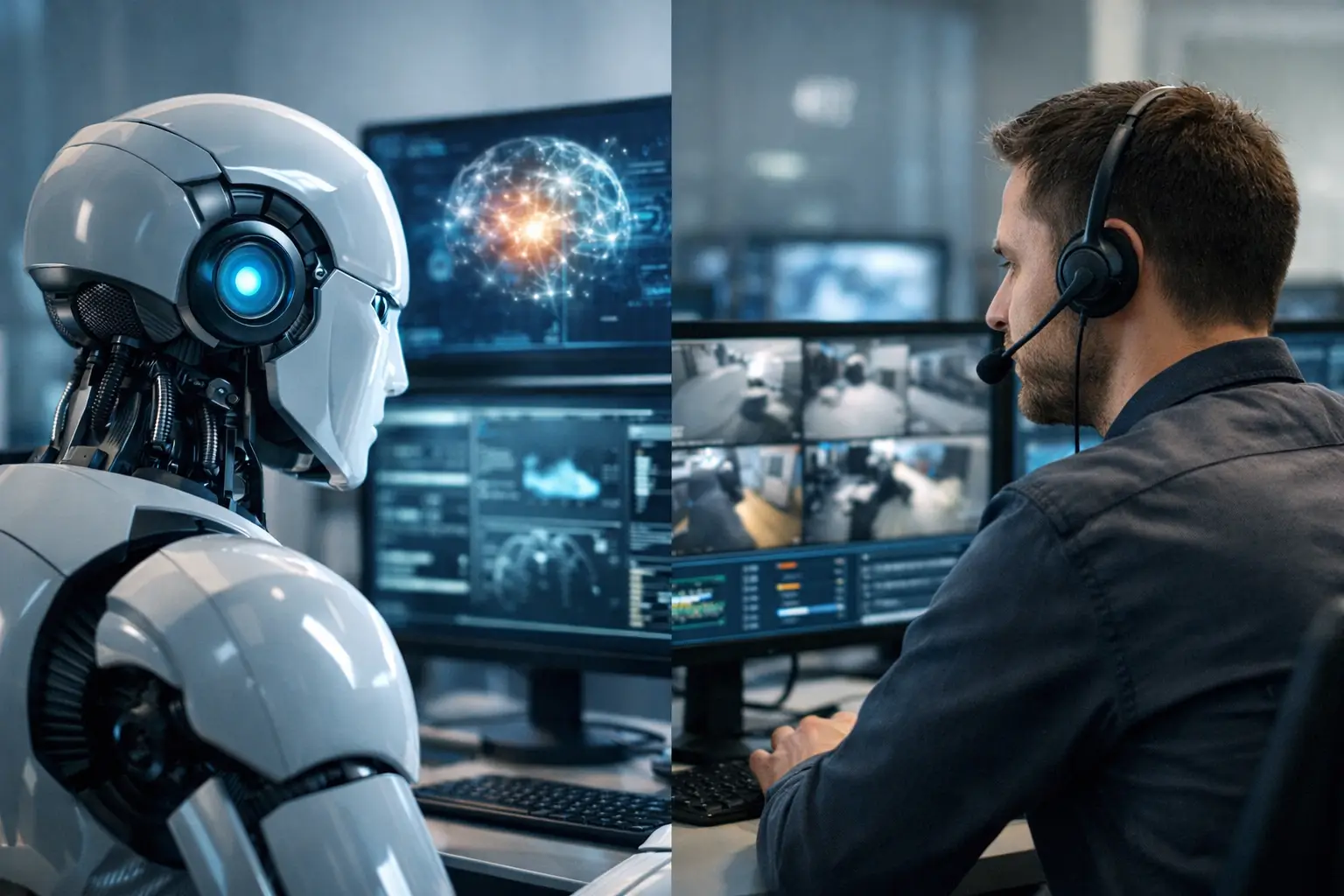
At 2:17 a.m., an alert can identify a threat indicator in seconds. It cannot always determine whether the post is credible, whether the location is relevant to your people, or whether the right next step is monitoring, escalation, welfare outreach, or emergency response. That is the real question behind AI monitoring vs security analysts: not which is more impressive, but which can protect people and operations when time and context matter.
For corporate security leaders, executive protection teams, HR professionals, and safety managers, the answer is rarely an either-or decision. AI provides the speed and coverage that modern risk environments demand. Experienced analysts provide the verification, judgment, and operational discipline that automated systems cannot reliably reproduce. The strongest security posture combines both.
AI Monitoring vs Security Analysts: The Core Difference
AI monitoring is built to process volume. It can scan large quantities of open-source information, news, social content, weather alerts, crime data, and location-based signals faster than any human team. It can detect keywords, entities, sentiment changes, emerging incidents, and patterns across broad geographic areas. That speed is valuable when a threat develops outside business hours or across multiple locations at once.
Security analysts work differently. They assess significance. A trained analyst can examine a concerning post, distinguish a vague grievance from a credible threat, identify missing context, evaluate behavior over time, and determine whether an issue has a clear connection to a protected person, facility, or event. They can also make decisions within established escalation protocols and document why those decisions were made.
The distinction matters because most security teams do not need more raw alerts. They need defensible intelligence that helps them decide what to do next.
What AI Does Well
AI is exceptionally useful for continuous monitoring. It does not lose focus at the end of a shift, and it does not struggle with the volume created by hundreds of facilities, traveling executives, remote employees, major events, or changing threat conditions.
Used properly, AI can detect early indicators that a manual process may miss. It can surface a spike in threatening language around a corporate location, identify public reports of civil disruption near a planned event, or flag a developing weather emergency affecting employees in the field. It can also prioritize signals based on configurable risk factors, reducing the time needed to locate potentially relevant information.
For organizations operating across regions, AI also creates consistency. The same monitoring criteria can be applied across offices and assets, while location-based risk visibility gives teams a clearer picture of where exposure is increasing. This is especially useful for executive travel, workplace violence prevention, large public gatherings, and distributed workforces.
What Security Analysts Do Well
Analysts bring investigative reasoning to an alert. They ask questions a model may not answer reliably: Is the source authentic? Is the language directed at a specific target? Does the subject have access, proximity, intent, or a history of escalation? Is a post old, satirical, copied, or already addressed by law enforcement?
That judgment prevents security teams from treating every signal as an emergency. It also prevents the opposite failure: dismissing a fragmented set of low-level indicators that, when reviewed together, show a meaningful and escalating concern.
Human analysts are particularly important when an organization must assess workplace violence concerns, threats to executives, stalking indicators, doxxing, insider-risk behaviors, or targeted harassment. These cases often require careful interpretation, evidence preservation, coordination with legal or HR stakeholders, and decisions that may affect an employee, family member, or protected principal.
A qualified analyst also understands operational consequences. Escalating a threat to executive protection, contacting local authorities, activating a crisis team, or initiating a welfare check are not merely classification outcomes. They are actions with legal, reputational, and human implications.
Why Automation Alone Creates Security Gaps
AI can produce false positives when language is ambiguous, context is unavailable, or terms have multiple meanings. A system may flag a post that appears threatening but is actually commentary about a movie, a sporting event, or a news story. At scale, those false positives can overwhelm teams and create alert fatigue.
False negatives are equally serious. Threat actors do not always use direct language. They may communicate through coded references, images, indirect statements, location clues, or a sequence of seemingly minor behaviors. Models can improve detection, but they cannot guarantee that every relevant pattern will be recognized or correctly interpreted.
There is also a governance issue. Security leaders need to explain how an alert became an escalation, what evidence supported the decision, who reviewed it, and what actions were taken. A black-box score without documented human review may be difficult to defend after an incident.
Automation should therefore be treated as an intelligence collection and prioritization capability, not as the sole authority for high-consequence decisions. The higher the potential impact on a person or organization, the more valuable expert review becomes.
Why Human-Only Monitoring Has Limits
A fully manual operation has a different set of vulnerabilities. Analysts cannot continuously review every data source, every jurisdiction, and every potential signal without support. Coverage can become uneven after hours, during surge events, or when teams are handling multiple cases at once.
Manual processes can also delay detection. By the time a report reaches the right person, a protest may have moved toward a facility, an executive’s travel route may have become unsafe, or an online threat may have spread across multiple channels. A skilled analyst is most effective when technology has already narrowed a vast information environment into a prioritized queue.
The issue is not whether analysts are capable. It is whether they are being deployed where their judgment has the greatest value. Asking experts to spend their time sorting routine noise is an inefficient use of a critical security resource.
The Hybrid Model: Faster Detection, Better Decisions
A hybrid model assigns each capability to the work it handles best. AI monitors continuously, detects patterns, and flags relevant changes. Analysts validate the signal, assess credibility and impact, and direct the escalation process. The result is faster awareness without sacrificing disciplined decision-making.
In a mature operation, this process should be connected to workflows rather than trapped in separate tools. A verified threat should move into a case record with supporting evidence, analyst notes, subject details, location information, assigned owners, and a documented response path. Teams should be able to track whether the issue is being monitored, investigated, escalated, or resolved.
That operational connection is where a unified security platform becomes valuable. Risk Shield combines AI-driven monitoring with human-verified analysis and incident management tools so organizations can move from detection to accountable action within one coordinated environment.
For example, consider a concerning social media post mentioning a corporate campus. AI may identify the location reference and threatening language immediately. An analyst can then review the account history, determine whether the subject appears local, compare the language with prior reports, and assess whether the statement meets internal escalation criteria. If it does, security can open a case, notify the appropriate stakeholders, preserve evidence, increase site awareness, and coordinate response measures.
The technology provides the speed. The analyst provides the judgment. The workflow ensures neither is lost in a disconnected handoff.
How to Decide What Requires Human Review
Not every alert warrants the same level of attention. Routine regional weather updates may be automated and distributed based on location. A report of an active threat near a workplace, a targeted threat toward an executive, or an employee concern involving potential violence should receive prompt human assessment.
A practical threshold is to require analyst review when an alert involves a named individual, a specific facility, a credible indication of intent, an immediate proximity concern, or a decision that could trigger law enforcement engagement, employee action, or protective measures. Review is also essential when information is incomplete but the potential consequence is high.
Organizations should define those thresholds before an incident occurs. Clear criteria reduce hesitation, limit inconsistent decisions, and help teams distinguish between intelligence worth watching and intelligence that requires action now.
Measure the Outcome, Not the Alert Volume
Security leaders should not judge a monitoring program by the number of alerts generated. High alert volume can indicate broad visibility, but it can also signal poor tuning and a team burdened by noise.
More useful measures include time from detection to review, percentage of alerts verified as relevant, time from verification to escalation, unresolved case aging, recurring threat patterns by location, and completion of response actions. These measures show whether intelligence is improving preparedness and response rather than simply creating more data.
The right balance will vary. A large enterprise with high-profile executives may require continuous analyst-backed monitoring and formal escalation coverage. A smaller organization may use AI for broad situational awareness while reserving expert review for defined high-risk triggers. The requirement should follow the organization’s exposure, duty of care, and ability to act on what it learns.
Protection is not achieved by collecting the most signals or employing the largest team. It is achieved when the right signal reaches the right person, is assessed with discipline, and leads to a timely, documented action that reduces risk.
