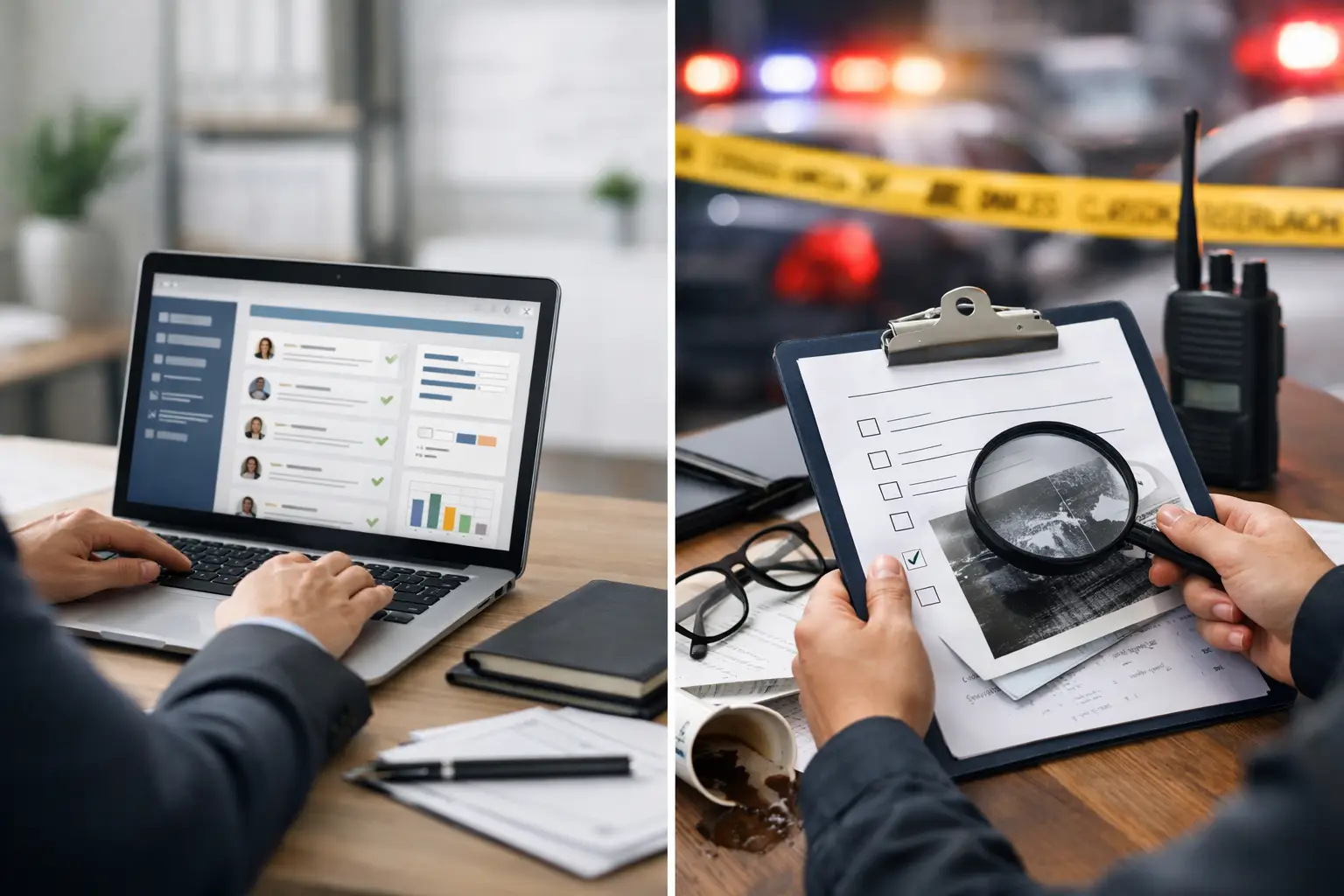
A threat report arrives at 8:12 a.m. It documents a concerning message, names the people involved, and captures the location. That record matters, but it does not tell the security team who will assess credibility, protect the potential target, preserve evidence, coordinate with HR or law enforcement, or determine whether the risk has ended. That is the operational difference in case management vs incident reporting.
Organizations often use the terms interchangeably because both involve documenting events. The result is a dangerous gap: a report may be filed, but no accountable process exists to investigate, escalate, act, and close the matter. For workplace violence concerns, executive protection issues, safety alerts, misconduct allegations, and emergency events, documentation alone is not protection.
What Incident Reporting Is Designed to Do
Incident reporting captures the initial facts of an event, observation, hazard, or concern. It is the first record created when an employee flags threatening behavior, a traveler activates an SOS alert, a facility manager reports a security breach, or an executive protection team identifies suspicious surveillance.
A strong incident report answers foundational questions: what happened, when and where it happened, who was involved, who submitted the report, and what evidence is available. It may include photos, video, witness statements, chat messages, GPS data, and immediate actions taken.
Its primary value is speed and consistency. A structured reporting process reduces the likelihood that critical facts are lost in informal emails, text messages, or verbal handoffs. It also creates a timestamped record that can support later investigations, regulatory obligations, insurance matters, internal reviews, or law enforcement coordination.
But an incident report is generally a point-in-time artifact. It describes what is known at submission. It does not, by itself, manage the evolving risk.
Consider a report that an employee made repeated threatening statements. The initial report can capture the language used and the witnesses present. Yet the risk may change within hours as additional messages surface, the employee misses work, or a protective order is issued. The organization needs more than a static form to manage that development.
What Case Management Is Designed to Do
Case management is the controlled workflow used to assess, investigate, coordinate, document, and resolve an issue over time. A case may begin with one incident report, several related reports, an intelligence alert, a referral from HR, or a direct request for assistance.
The case becomes the operational record for the full response. It assigns ownership, tracks tasks and deadlines, stores evidence, records decisions, restricts sensitive access, and preserves a chronological audit trail. It also gives leadership a defensible view of whether protective actions were considered and completed.
For a workplace threat concern, the case file may include threat assessment findings, interview notes, behavioral indicators, prior incidents, security posture changes, welfare checks, legal guidance, and communications with stakeholders. For executive protection, it may include route risk analysis, event intelligence, suspicious activity observations, travel updates, and protective measures.
The central purpose is accountability. A case has a responsible owner, a status, a response plan, and a documented path toward resolution or ongoing monitoring. It turns concern into managed action.
Case Management vs Incident Reporting: The Core Difference
The simplest distinction is this: incident reporting records an event, while case management directs the response to a risk.
Reporting is usually broad and accessible. Employees, contractors, travelers, family members, or security personnel may all need a simple way to submit a concern quickly. Case management is more controlled because it contains sensitive investigative material, assessment decisions, personal information, and operational plans.
Reporting is also often immediate. The person submitting the form may have limited information and may not know whether the issue is serious. That is acceptable. A well-designed intake process should make reporting easy without requiring the reporter to make a security judgment.
Case management begins when the organization determines that the report needs active handling. Some reports can be closed after review because they are duplicates, lack sufficient information, or reflect a resolved low-level issue. Others require escalation because of credibility, vulnerability, pattern, proximity, access to weapons, threats of violence, or exposure to protected individuals.
The distinction matters because treating every report as a case overwhelms security teams with administrative work. Treating serious reports as mere records creates the opposite problem: warning signs remain scattered, ownership is unclear, and no one can demonstrate that the organization acted.
How Reporting and Case Work Together
These functions should connect, not compete. The most effective model uses incident reporting as a disciplined intake channel and case management as the command structure for active response.
When a report is submitted, predefined triage rules should route it according to severity, location, subject, and type of threat. A report involving an active threat, medical emergency, or immediate danger requires emergency escalation. A report involving concerning behavior, repeated harassment, or suspicious activity may require review by security, HR, legal, or a threat assessment team.
If the issue meets the threshold for active management, the report should create or attach to a case. The original submission remains preserved as source evidence, while the case captures all subsequent actions. This protects the integrity of the original account and prevents investigators from relying on disconnected notes.
A single case can also link multiple incidents. That capability is essential for identifying patterns that no individual report reveals. One report of unwanted contact may be isolated. Three reports from different locations involving the same individual, vehicle, or digital account may indicate stalking, targeted surveillance, or an escalating threat.
When a Report Should Become a Case
The threshold depends on an organization’s risk profile, resources, and legal obligations. A hospital, school, corporate campus, and executive protection operation will not use identical criteria. Still, certain triggers consistently warrant case-level review.
A report should be considered for a case when it involves a credible threat, repeated conduct, a vulnerable person, physical violence, stalking, weapons, a protected executive, significant property damage, or potential legal exposure. The same applies when multiple reports appear connected or when an issue requires action across departments.
Time is another factor. If resolution requires more than a simple, documented correction, it is likely a case. For example, a broken access-control door may be an incident that facilities can repair and close. If the failure allowed repeated unauthorized entry, exposed sensitive operations, or suggests insider involvement, it becomes a broader case requiring investigation and mitigation.
Organizations should avoid relying on vague instructions such as “escalate when needed.” Clear triage criteria, severity levels, and assignment rules help frontline personnel act with confidence under pressure.
The Data and Governance Requirements Are Different
Incident reports need enough structure to support fast, accurate intake. Required fields should be limited to information needed for triage, while allowing reporters to add narrative and evidence. Overly complex forms discourage reporting at the moment it matters.
Case files require deeper controls. Access should be role-based, especially when records include medical details, employee relations matters, intelligence sources, security plans, or personally identifiable information. Case actions should be time-stamped, evidence should be preserved in its original form, and changes should be auditable.
Retention rules also differ. A brief, low-risk report may follow a standard retention schedule. A case involving violence, litigation, or a continuing threat may require longer preservation and tighter legal review. Security leaders should align these rules with counsel, HR, privacy requirements, and sector-specific obligations.
What Technology Should Support
Technology should reduce friction at intake while giving responders command of the full operational picture. The right platform allows users to report from the field, upload evidence, share location when appropriate, and trigger urgent support without forcing them to navigate a complex system.
For security teams, the platform should support triage queues, case assignment, escalation paths, activity logs, investigative timelines, evidence management, and analytics. It should also surface relationships across incidents, people, places, and behaviors. That is where incident data becomes actionable intelligence rather than a collection of closed forms.
Risk Shield’s approach reflects this operational need by bringing threat intelligence, verified analyst support, SOS capabilities, evidence capture, and centralized case workflows into one protection environment. The objective is not simply to record more events. It is to identify what demands action, coordinate the right response, and retain a defensible record of every decision.
Build a Response Model That Holds Under Pressure
Security programs do not fail because teams lack forms. They fail when information arrives without ownership, escalation lacks discipline, or critical details remain divided across email inboxes, spreadsheets, and disconnected systems.
Start with a reporting channel people will actually use. Define who triages incoming information, how urgency is determined, and which events automatically require case creation. Then test the workflow against realistic scenarios: a threat to an employee, a suspicious person near an executive residence, a travel disruption, or a repeat harassment complaint.
The goal is not to make every event look like a major investigation. The goal is to ensure that the events that matter do not disappear into a recordkeeping process. When the next report arrives, your team should already know who owns the decision, what evidence to preserve, and how protection will move from observation to action.
