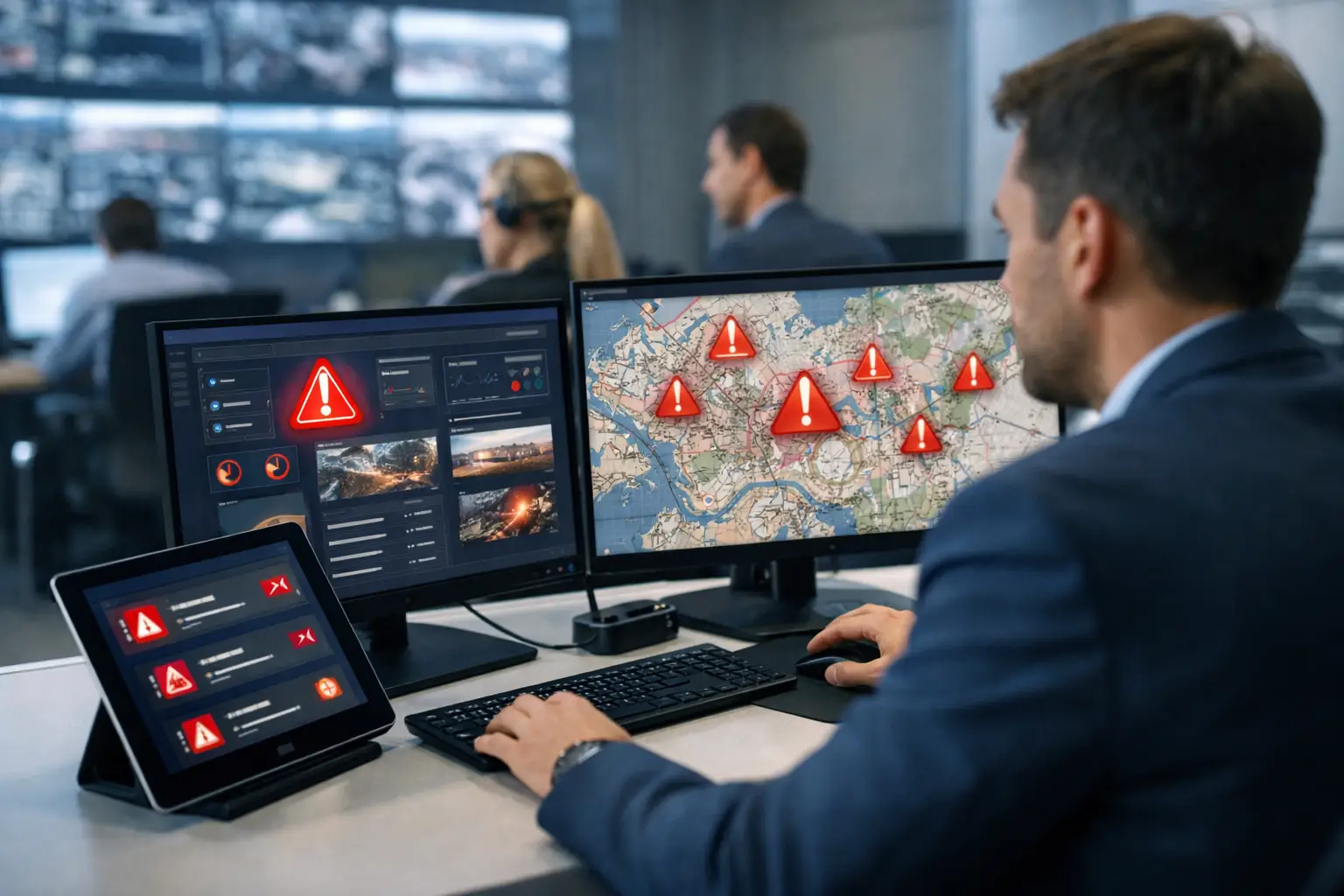
A threat bulletin arrives. An employee reports concerning behavior. Severe weather moves toward a facility where executives, staff, or travelers are operating. The issue is not whether security teams can find information. It is whether they can determine what matters, identify who is exposed, and direct a response before a developing risk becomes an incident. Risk alert platforms are built to close that operational gap.
Generic news feeds and mass notification tools can create awareness, but awareness alone does not protect people. Security leaders need verified intelligence, location context, clear escalation paths, and documented actions in one operating picture. The right platform helps teams move from monitoring events to managing risk.
What Risk Alert Platforms Must Do
A risk alert platform should not function as another noisy inbox. Its purpose is to identify relevant threats, assess potential exposure, and support informed action at speed. That requires more than automated keyword matching or broad regional alerts.
A credible system combines real-time data collection with analyst judgment. AI can monitor large volumes of public information, identify patterns, and surface emerging signals faster than a human team working manually. But high-consequence security decisions still require verification, context, and disciplined escalation. A post may be inaccurate, old, mislocated, or irrelevant to the organization. Sending it forward without review can create confusion and alert fatigue.
The strongest model pairs machine-scale monitoring with human-verified analysis. Analysts can validate sources, distinguish credible threats from speculation, identify connections between events, and explain why an alert matters to a particular organization. That distinction is critical when the subject involves workplace violence, executive travel, civil unrest, targeted threats, or a rapidly changing emergency.
Location is equally important. A credible threat several states away may not require action. A lower-profile event near a school, office, residence, hotel, or travel route may demand immediate attention. Security teams need to see risk in relation to the people and assets they are responsible for protecting.
The Operational Capabilities That Matter
The value of a platform is measured by what happens after an alert appears. Can the right people receive it? Can they determine who may be affected? Can they coordinate a response and retain a defensible record of what occurred? These questions separate operational tools from information feeds.
Threat Intelligence With Context
Effective intelligence is specific enough to support a decision. Instead of simply reporting that a protest, crime pattern, or weather event exists, an alert should explain the location, likely impact, timing, confidence level, and recommended considerations. This allows corporate security, executive protection, HR, and operations leaders to set priorities quickly.
Context also reduces false positives. A platform should allow teams to define monitored locations, people, facilities, routes, and categories of concern. An executive protection detail may need alerts tied to an itinerary and principal profile. A workplace safety team may focus on facilities, employee reports, and threat indicators. A family may prioritize home, school, and travel locations. The intelligence should adapt to the protection mission, not force every user into the same alert stream.
Escalation and Response Workflows
An alert has limited value if it cannot trigger action. Teams need defined procedures for acknowledging a threat, assigning ownership, documenting decisions, notifying affected personnel, and closing the case when conditions stabilize.
For example, a verified report of a credible threat near a corporate office may require a facility review, access-control adjustments, employee communication, law enforcement coordination, and executive notification. The platform should make those actions visible without relying on fragmented texts, emails, and spreadsheets. When responsibility is clear, response time improves and leadership gains a more accurate picture of the situation.
SOS functionality can be especially important for employees, travelers, executives, and families. A request for help should immediately provide the responder with location information, available incident details, and a direct path to escalation. In a real emergency, people should not have to search for the right contact, explain their location repeatedly, or rely on a message chain that no one is monitoring.
Centralized Case Management and Evidence
Security incidents rarely end with the first alert. Teams may need to gather screenshots, upload photos or documents, record witness information, track investigative steps, and preserve a timeline for legal, HR, insurance, or compliance review.
Centralized case management helps maintain continuity from initial signal through resolution. It also protects against a common operational failure: critical details being scattered across individual devices and disconnected systems. When an incident becomes more serious, leadership needs facts, not reconstruction from memory.
Where Risk Alert Platforms Produce the Greatest Value
Organizations see the strongest return when the platform supports a defined protection objective. For corporate security teams, that may mean protecting dispersed facilities and employees during disruptive events. For HR and workplace safety leaders, it may mean documenting concerning behavior and coordinating threat assessment before conduct escalates. For executive protection professionals, it may mean monitoring travel destinations, residences, routes, and reputational or physical threats to a principal.
The platform can also support business continuity. During severe weather, transportation disruption, civil unrest, or localized emergencies, security teams must rapidly determine which sites and personnel are exposed. A location-aware view makes it easier to prioritize outreach, deploy resources, and provide leadership with a clear status update.
For individuals and families, the use case is more personal but no less serious. Travelers may need destination-specific alerts and a direct way to request assistance. Parents may want immediate awareness of risks near schools or family members. High-net-worth households may require ongoing visibility around residences, events, and travel. The level of monitoring should fit the risk profile, but the operating principle remains the same: early warning is most valuable when it leads to prepared action.
How to Evaluate a Risk Alert Platform
Security leaders should begin with operational requirements, not a feature checklist. Ask what threats create the greatest exposure, who must receive alerts, what information responders need, and how actions are currently documented. Then assess whether a prospective platform can improve those specific workflows.
Consider the quality of intelligence first. Does the provider explain how alerts are sourced, verified, and prioritized? Are human analysts available when a situation requires judgment? A high volume of alerts may look comprehensive, but it can burden a team if most notifications are irrelevant or unverified.
Next, evaluate location capabilities. The platform should support the locations that matter to your operation, including facilities, travel routes, event venues, homes, schools, and temporary work sites. Geographic relevance should be precise enough to identify exposure without overwhelming users with distant activity.
Integration matters as well. Security operations often depend on existing communication channels, access systems, HR processes, travel programs, and emergency protocols. API integrations and structured workflows can reduce duplicate work, but only if they fit the organization’s real response model. A platform that is highly configurable may be valuable for a complex enterprise, while a smaller team may benefit more from clear, prebuilt workflows and analyst support.
Finally, examine adoption under pressure. Can employees submit an incident from a mobile device? Can a manager find current case status in seconds? Can a security operator see open tasks, affected locations, and response history without switching between systems? The answer should be tested through realistic scenarios, not a polished demo alone.
Technology Does Not Replace Preparedness
Risk alert platforms can improve visibility and response discipline, but they cannot compensate for unclear authority, outdated emergency plans, or teams that have never practiced escalation. Technology works best when it reinforces a defined operating model: who monitors, who decides, who communicates, and who documents.
That is why implementation should include alert thresholds, contact validation, escalation procedures, and periodic exercises. A workplace violence alert should be tested differently from a weather disruption or an executive travel concern. The goal is not to automate every decision. It is to ensure people have timely intelligence, a common operating picture, and a clear path to action.
Risk Shield brings these capabilities together through AI-driven monitoring, human-verified intelligence, location-based visibility, SOS support, and centralized incident management. For teams responsible for protection, the standard is simple: when risk begins to develop, the right people should know what is happening, understand what is at stake, and be ready to act.
