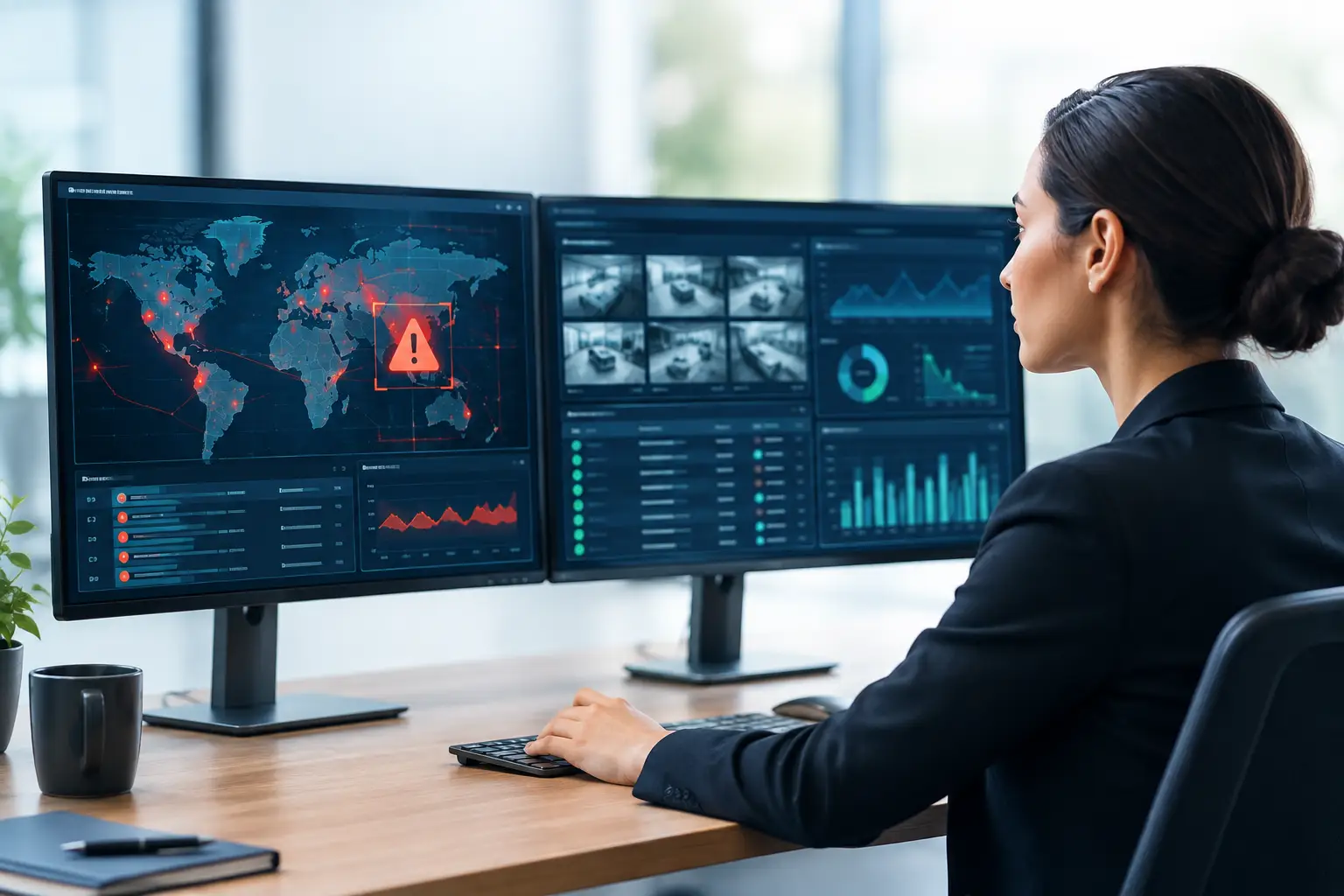
A troubling social media post appears near an office. A severe weather alert moves toward a manufacturing site. An executive’s travel itinerary overlaps with civil unrest. These events do not carry the same urgency, but each can become operationally significant quickly. That is where the distinction between AI threat detection vs monitoring matters. Monitoring creates persistent visibility. Detection identifies the signals within that visibility that may require assessment, escalation, or action.
For security leaders, HR teams, executive protection professionals, and families responsible for people’s safety, treating these capabilities as interchangeable leaves gaps. A high volume of alerts without prioritization can bury a team. A detection tool without broad, continuous visibility may miss the conditions that give an incident context. Effective protection requires both, supported by disciplined workflows and human judgment.
AI Threat Detection vs Monitoring: The Operational Difference
Threat monitoring is the continuous collection and tracking of information relevant to a person, location, organization, or mission. Sources may include public safety reporting, weather and natural hazards, social media, local events, travel disruptions, online threats, and internal incident reports. The purpose is situational awareness: understanding what is happening, where it is happening, and whether conditions are changing.
AI threat detection is the analytical process that identifies patterns, anomalies, language, behaviors, or combinations of signals that indicate a potential threat. It moves beyond observing information to asking whether that information is relevant, credible, and urgent enough to require review or intervention.
The difference is practical. Monitoring may show that a protest is planned two blocks from a corporate office. Detection may identify a credible post naming that office, a rapid increase in hostile conversation, or a pattern that suggests a protest could disrupt access, target personnel, or create a safety concern. Monitoring provides the operating picture. Detection helps determine what deserves attention within it.
Neither function should operate in isolation. Monitoring without detection often produces alert fatigue. Detection without adequate monitoring can lack the geographic, historical, or situational context needed to assess risk accurately.
What AI Does Well – and Where It Needs Oversight
AI can process far more information than a security team can review manually. It can scan high-volume data streams, classify content, identify location references, recognize emerging themes, and correlate events over time. For distributed organizations, that scale is essential. A risk manager should not have to choose between watching every facility and protecting the people at greatest risk.
In a monitoring environment, AI can organize incoming information by location, threat type, severity indicators, and relevance to protected assets. In detection, it can flag unusual activity, identify threatening language, connect related reports, and surface events that match established risk criteria.
But AI does not replace assessment. A phrase may be sarcastic, a location reference may be inaccurate, and a fast-moving news item may be incomplete. Automated systems can also overestimate risk when they cannot account for local context, source credibility, or intent.
Human review is most valuable at the point where an alert could drive a consequential decision. Analysts can validate source reliability, separate vague hostility from a credible threat, determine whether a person or site is truly implicated, and recommend appropriate escalation. This hybrid model reduces false positives without forcing teams to wait for manual review of every data point.
A useful standard is simple: let AI identify what may matter; let trained people determine what it means and what should happen next.
Monitoring Is Continuous, Not Passive
Some organizations define monitoring as receiving alerts from several disconnected tools. That approach creates activity, not necessarily visibility. If weather updates sit in one system, employee concerns in another, travel risks in email, and incident records in a separate database, decision-makers spend valuable time assembling the picture during a crisis.
Effective monitoring connects external conditions to internal operations. It answers questions such as: Which facilities are inside the affected area? Which employees are scheduled to travel through it? Has the organization received related reports before? Who owns the response? What evidence needs to be preserved?
Location-based visibility is central to this work. A broad regional alert may be informational for one site and urgent for another. Monitoring should recognize the difference, then route intelligence to the people responsible for that location, individual, or protective detail.
It should also continue after an initial alert. Risk conditions change. A peaceful event can turn disruptive. A weather advisory can become an evacuation concern. A concerning message may be followed by additional posts, proximity indicators, or direct contact. Continuous monitoring keeps the operational picture current instead of treating risk as a one-time notification.
Detection Must Be Tied to Clear Thresholds
Detection becomes useful when the organization defines what qualifies as a threat and what each level of concern requires. Without thresholds, even sophisticated analytics can create uncertainty: teams see a flag but do not know whether to document, investigate, notify leadership, activate emergency procedures, or contact law enforcement.
A practical detection framework evaluates four factors:
- Credibility: Is the source identifiable, reliable, or corroborated?
- Intent: Does the language or behavior indicate planning, targeting, or a stated desire to cause harm?
- Capability: Does the subject appear able to act on the threat?
- Proximity: Is there a connection to a protected person, workplace, school, residence, route, or event?
These factors do not produce a perfect prediction. They provide a defensible method for prioritizing review and response. A direct threat with a named target and known proximity demands a different posture than generalized online anger with no connection to the organization.
For workplace violence prevention, this distinction is especially important. Detection should support a structured assessment process, not encourage security teams to treat every concerning behavior as proof of imminent violence. Fair, consistent evaluation protects employees while helping organizations avoid both underreaction and unnecessary escalation.
The Real Test Is What Happens After an Alert
Technology should not end at notification. The value of monitoring and detection is measured by whether the organization can act with speed, coordination, and accountability.
When a threat is detected, the response workflow should bring together the relevant intelligence, decision owners, and documentation. Teams may need to verify the event, contact affected personnel, adjust travel or site access, initiate an executive protection response, create a case, preserve screenshots or other evidence, and record decisions as the situation develops.
This is why centralized case management matters. It prevents critical details from being scattered across text messages, email threads, and personal notes. It also creates an incident record that supports post-event review, regulatory obligations, legal defensibility, and improved future response.
A mature platform can connect alerts to maps, asset lists, response plans, SOS capabilities, evidence uploads, and escalation paths. Risk Shield applies this operating model by combining AI-driven intelligence with human-verified analysis and incident management tools. The objective is not more notifications. It is a clearer path from emerging risk to accountable protective action.
Choosing the Right Balance for Your Risk Profile
The right mix of AI monitoring and detection depends on the people and assets you protect. A national company with multiple sites may prioritize geographic monitoring, severe-weather intelligence, workplace risk indicators, and centralized incident workflows. An executive protection team may need travel-focused alerts, route awareness, event intelligence, and rapid escalation for a principal. Families and individual users may place greater value on localized alerts, SOS support, and the ability to communicate quickly during an emergency.
The common requirement is relevance. An alert that does not account for your locations, people, operations, and response capacity is noise. A detection capability that cannot be reviewed, documented, and acted upon is only a signal.
Security leaders should ask whether their current system can show what is happening near protected people and places, identify which developments are genuinely concerning, validate uncertain signals, and coordinate the next action. If the answer requires several disconnected tools and manual workarounds, the organization is likely operating with avoidable delay.
Preparedness is built before the incident. Establish thresholds, assign escalation owners, test communication paths, and make sure analysts and decision-makers have the same operating picture. When the next signal emerges, the goal is not to collect more information. It is to protect people with the confidence that comes from verified intelligence and a response plan already in motion.
