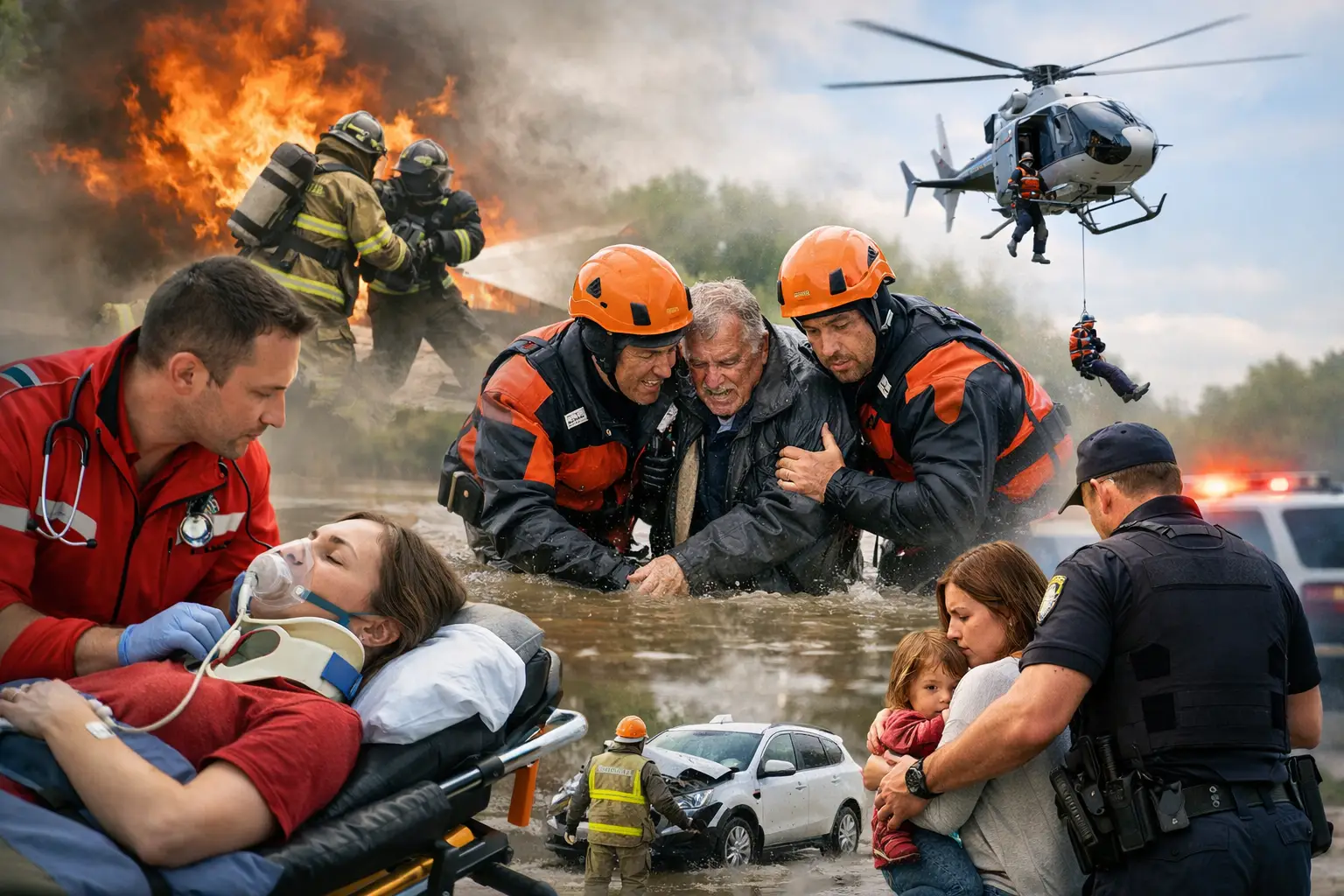
At 10:17 a.m., a facilities manager receives a report that an employee has threatened a coworker in the parking garage. The difference between a contained incident and a dangerous escalation is rarely luck. It is the quality of the response plan, the speed of verification, and whether the right people can act from the same operational picture. These emergency response examples show what disciplined action looks like when the facts are incomplete and the stakes are high.
A response plan is not a binder that appears after an incident. It is a decision structure: who verifies the threat, who has authority to escalate, how people receive instructions, where evidence is secured, and how leaders maintain accountability until the risk is resolved. The following scenarios apply that structure to common security and safety events.
7 Emergency Response Examples for Security Teams
1. Workplace violence threat
A supervisor reports that a terminated employee has sent hostile messages and may return to the office. The initial response should not assume the threat is either harmless or imminent. Security gathers the messages, identifies the individual’s last known location and access credentials, checks recent behavior or prior incidents, and initiates a threat assessment.
If the threat meets escalation criteria, the organization restricts building access, notifies reception and security personnel with a verified photo and instructions, and coordinates with law enforcement as appropriate. Employees who may be directly affected receive clear, need-to-know guidance rather than vague reassurances. The incident commander documents every decision, contact attempt, and protective action.
The trade-off is important. Overreacting can disrupt operations and create unnecessary alarm. Underreacting can leave people exposed. A structured assessment helps leaders make defensible decisions based on behavior, capability, access, and stated intent rather than instinct alone.
2. Active assailant report on campus or at a facility
A caller reports hearing gunfire near a building entrance. The first operational objective is life safety, not complete information. Dispatch or security immediately verifies the location through available cameras, access-control data, witnesses, and emergency services while sending a plain-language alert to those at risk.
The message must tell people what to do: avoid the area, evacuate if a safe route exists, or shelter in place if movement would increase exposure. It should identify the location, provide a time stamp, and state when the next update will be issued. Security teams should avoid broadcasting tactical details that could endanger responders or help an attacker.
Once first responders take command, the organization supports them with floor plans, camera access, badge data, visitor records, and a current accounting of employees. After the immediate threat, leaders still have critical work: reunification, medical support, employee communications, evidence preservation, and a documented after-action review.
3. Suspicious package or bomb threat
A mailroom employee discovers a package with no return address, excessive tape, and an unusual odor. The correct response is controlled distance. Do not handle, open, shake, or move the item. Isolate the area, prevent others from approaching, and contact emergency services and internal security.
Bomb threats require the same discipline even when delivered by phone, email, or social media. Preserve the original communication, capture available metadata, record the caller’s wording if applicable, and assess the specificity of the threat. Details such as a stated location, timing, target, or method can shape evacuation and search decisions.
Evacuation is not automatic in every case. Moving people through a suspected hazard area can create additional risk. Security leadership and responding authorities must determine whether evacuation, sheltering, or a partial facility closure is safer based on the threat details and site conditions.
4. Severe weather and natural disaster
A tornado warning, wildfire encroachment, flood, or earthquake can disable roads, communications, power, and normal command structures within minutes. The best response begins before the alert. Teams need predefined shelter locations, evacuation routes, accountability procedures, backup communications, and continuity plans for essential operations.
When a warning is issued, leadership should communicate the protective action in direct terms. For a tornado, move to designated interior shelter areas away from windows. For a wildfire, act on evacuation orders early and account for personnel before routes become congested. For flooding, do not send employees into low-lying areas or across compromised roads simply to maintain operations.
After the event, a personnel accountability check is essential. Teams should record who is safe, who requires assistance, who cannot be contacted, and which sites are inaccessible. That information directs welfare checks and prevents rumors from becoming operational noise.
5. Medical emergency at a remote worksite
A lone technician collapses at a customer location, or a field employee reports chest pain from a vehicle. In these cases, response depends on accurate location intelligence. A dispatcher needs the employee’s precise location, callback number, condition if known, nearby hazards, and whether another person can provide aid until emergency medical services arrive.
The employee or witness should be instructed to call 911 when possible. Internal teams can simultaneously notify local emergency contacts, direct a nearby supervisor to the scene, and maintain an open communication channel. If an SOS tool is used, the platform should capture location, time, incident notes, and any supporting media without forcing the employee to navigate a complicated process under stress.
A strong post-incident process protects both the employee and the organization. It records the timeline, confirms care was received, identifies whether travel or work conditions contributed to the event, and protects sensitive medical information from unnecessary distribution.
6. Executive travel disruption and targeted threat
An executive traveling for a public event receives online threats that reference the hotel and meeting schedule. This is not just a travel inconvenience. It is a protective intelligence problem involving threat credibility, location exposure, digital risk, and movement planning.
The response team verifies the source, assesses whether the language indicates fixation or operational knowledge, and reviews the executive’s itinerary for predictable points of exposure. Protective measures may include changing transportation arrangements, tightening access to event information, coordinating with venue security, or relocating the principal. The right action depends on the threat’s credibility and the executive’s public profile.
This scenario illustrates why fragmented tools create delay. Travel details in one system, threat reports in another, and incident notes in email force teams to assemble the picture during the most time-sensitive period. Centralized case management gives security leaders one record for alerts, assessment decisions, communications, evidence, and follow-up actions.
7. Cyber incident with physical operational impact
A ransomware attack locks a manufacturing site’s systems, including badge access, visitor management, and portions of the building automation system. The event begins as a cyber incident but becomes a physical security issue when normal controls fail.
The response requires cyber, facilities, security, legal, and operational leaders to work from a shared command structure. Security may need to shift to manual access control, suspend nonessential visitors, deploy officers to sensitive areas, and verify that fire and life-safety systems remain functional. Leaders should communicate what is known, what systems are affected, and what employees must do differently.
Do not treat manual workarounds as an afterthought. They need ownership, logs, shift coverage, and clear criteria for returning to normal operations. Every manual entry, visitor approval, and security exception may become important evidence during recovery and investigation.
What Strong Emergency Response Has in Common
These emergency response examples differ in cause, but the operating principles are consistent. Teams need verified intelligence before they spread information, clear escalation thresholds, and communications that direct action rather than create confusion. They also need a record of what happened, who decided, and why.
A practical response workflow includes four connected actions: detect the signal, verify the facts, escalate to the correct authority, and document the outcome. Technology can accelerate each stage through location-based alerts, SOS activation, evidence upload, case management, and analytics. Human analysts and experienced security professionals remain essential when context determines whether an alert is routine, credible, or urgent.
For organizations managing multiple sites, travelers, remote workers, or high-profile personnel, consistency matters as much as speed. A unified platform such as Risk Shield can help teams connect threat monitoring, incident reporting, response coordination, and documentation in one operational view. That reduces handoffs, limits false positives, and gives decision-makers a clearer basis for escalation.
The most useful test of any emergency plan is simple: when an alert arrives at an inconvenient hour with incomplete facts, can your team identify the risk, protect people, communicate clearly, and preserve the record without losing time? If the answer is uncertain, the next incident should not be the first full-scale test.
